



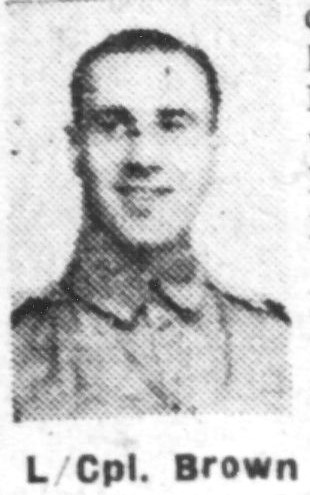
Dixon Brown
This story is shared by the Trust with kind permission from Mavis Williams, Researcher.
Dixon Brown was born on the 15th November 1919 in the South Shields, Durham, registration district, the son of John Dixon & Hannah Louisa Brown (née Lowes), who married in the same district in the June quarter of 1912.
By the 1921 census, the family had grown and they were living at 24, Gladstone Street, Hebburn, Durham. John Brown, 33 was an Engineering Patternmaker for the North Eastern Marine Engineering Co., Wallsend-on-Tyne and Hannah was doing Home Duties. Their children were James Brown, 8 years and 4 months old, Florence Isabella Brown, 5 years and 1 month old and Dixon Brown, 1 year and 7 months old and had all been born in Hebburn-on-Tyne, Co. Durham. His father-in-law, Luke Lowes, was also living with them as was his brother-in-law, Oliver Lowes. Luke Lowes was working as Labourer for Foster Blackett & Wilson Lead Works, Hebburn-on-Tyne and his brother-in-law, Oliver, 28, was described as Mentally deficient, no occupation.
On the 5th of September 1931, tragedy struck the family when Hannah Louisa Brown died at 24, Gladstone Street, aged 43 years, of Heart Failure and Lobar Pneumonia (Bilateral).
After leaving school Dixon Brown worked as a clerk with the Bushing Co., Hebburn and also joined the Territorials. By the 1939 National Register, which was taken on the 29th of September 1939, 26 days after was declared, we find Florence Isabella Brown living at 17 North Farm Road, Hebburn. She is the only occupant at that address as John Brown, Dixon Brown and James Brown were all in the forces. She is doing Unpaid Domestic Duties and she is also in the A.R.P. (Air Raid Precautions) (First Aid). She was later to marry James C. Gemmell in the Durham N.E. registration district in the December quarter of 1942.
Articles in the local newspapers in 1942 and 1943 give us an insight to where John, Dixon and James were in 1939.
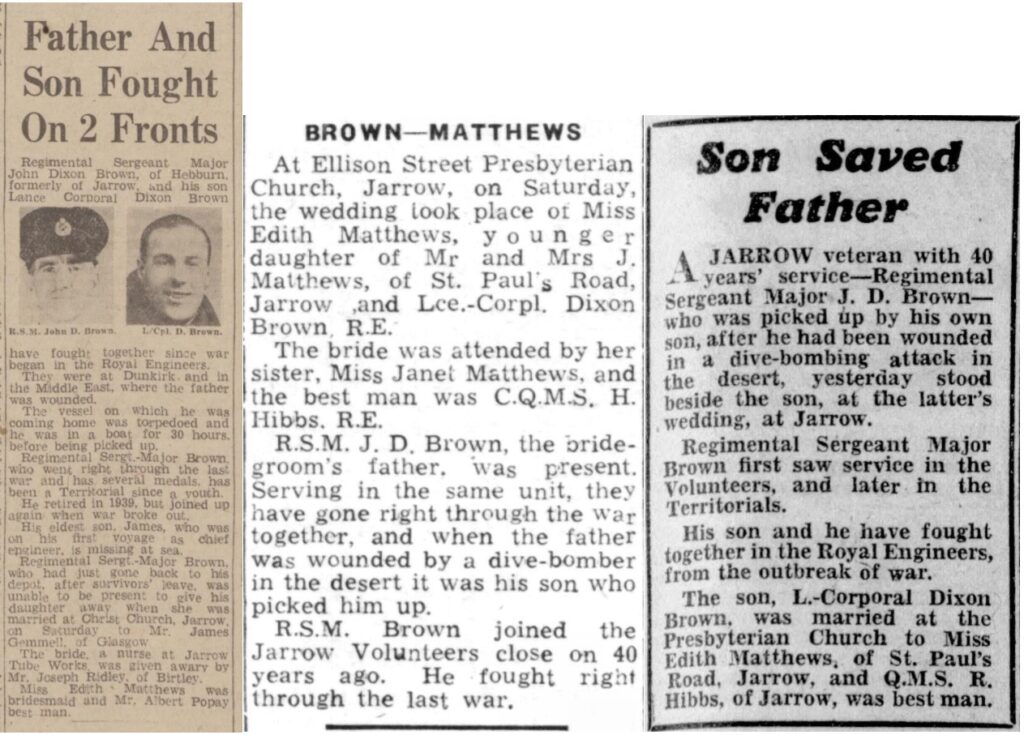
Newsclippings, L-R: Newcastle Journal, 30 November 1942; Shields Daily Gazette, 22 November 1943; Sunday Sun Newcastle 21 November 1943
John Brown and his sons, James and Dixon had been called up at the start of the war. John Brown had served in WW1 and had won several medals. He had been a Territorial since his youth and had retired in 1939 but joined up again in 1939 when war broke out. Both Regimental Sergeant Major John Dixon and Dixon had fought together in the same unit since the start of the war. Dixon had enlisted on the 27th May 1939 in Jarrow and he and his father served at Dunkirk and in the Middle East. When John Brown was wounded by a dive-bombing attack in the desert, it was his son who picked him up.
The vessel on which John Brown was coming home on was torpedoed and he was in a boat for 30 hours before being picked up. He had just gone back to his depot after survivor's leave so he was unable to be present to give his daughter, Florence, away when she got married in November 1942 at Christ Church, Jarrow to Mr. James Gemmell, of Glasgow. We also discover that his eldest son, James Brown, was on his first voyage as Chief Engineer, but at this point he had been reported as missing at sea.
The death of James was official confirmed one month after the wedding of his sister in December 1942. James had been killed on the 15th of July 1942 on the M.V. Empire Attendant (Glasgow). At 03.30 hours his ship had dispersed from convoy OS-33, and was torpedoed and sunk by U-582 south of the Canary Islands. The master, 49 crew members and nine gunners were lost. He is remembered on the Tower Hill Memorial. James had married Ada Maud Hayward in 1934 and he left behind his wife, two sons and a daughter.
Dixon Brown married Miss Edith Mathews on the 20th November 1943 at the Ellison Street Presbyterian Church, Jarrow. She was the younger daughter of Mr. & Mrs. J. Mathews of St. Paul’s Road, Jarrow.
Seven month later, Dixon Brown landed on the beaches of Normandy on D-Day. His unit, 233 Field Company, Royal Engineers was part of 50th (Northumbrian) Infantry Division on D-Day. They were deployed to clear mines and obstacles on the beach. The company was split to serve under the command of the Assault and Reserve waves of infantry.
1 and 4 Sections landed with the Assault parties on King Green sector, Gold Beach around 07:25. As the last men waded ashore mortar bombs landed on the beach, killing some of them. 2 and 3 Sections landed with the reserve troops in the late afternoon on King Green sector, Gold Beach but some were killed as they landed. It is presumed he was killed during one of these incidents.
News of his death was reported in the Shields Gazette of the 12th August
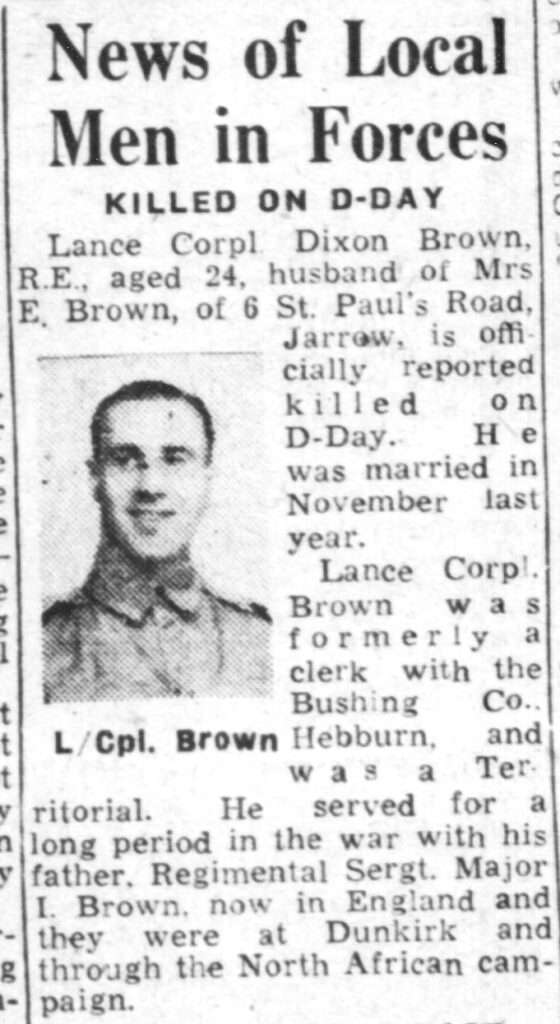
He was first buried at Ver-sur-Mer and then reburied on the 1st December 1944 in the Bayeux War Cemetery.
Edith Brown (née Mathews) was to marry James Teasdale in the September quarter of 1949 and I believe that John Brown died in the Durham North Eastern Registration district in the March quarter of 1952. Dixon Brown’s sister, Florence Isabella Gemmell (née Brown) died in the June quarter of 1986 in the South Shields registration district.
FALLEN HEROES
DIXON BROWN
Army • LANCE CORPORAL
Royal Engineers
233 Field CompanyDIED | 06 June 1944
AGE | 24
SERVICE NO. | 2091163
FALLEN HEROES
DIXON BROWN
Army • LANCE CORPORAL
Royal Engineers
233 Field CompanyDIED | 06 June 1944
AGE | 24
SERVICE NO. | 2091163
FEATURED SHOP ITEM
£25
ORDERStanding with Giants Puzzle
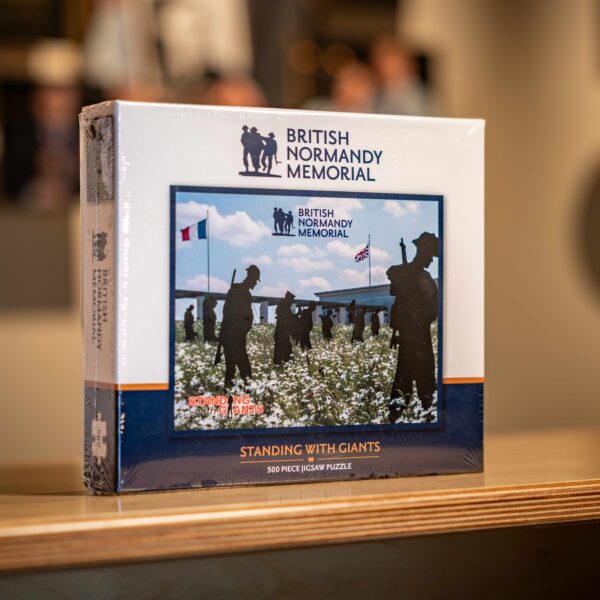
Bring a powerful moment of remembrance into your home with our Standing with Giants 500-piece jigsaw puzzle. Featuring the striking silhouettes installation at the British Normandy Memorial, this beautifully produced puzzle captures the scale and emotion of the tribute.

£22
ORDERD-Day Sculpture Crystal Block
Laser-engraved within a solid crystal block, the detailed three-dimensional image can be viewed from different angles, creating a striking display piece.

£16.99
ORDERNorman D. Mouse & Book Gift Set
Meet Norman D. Mouse, the little mouse with a very big story to tell!