



Finn Varde Jespersen and the crew of ND815
This story is shared by the Trust with kind permission from Haakon O. V. Vinje, Head of the Norwegian War Graves Service
Remembering the crew of ND815, 97 (Straits Settlements) Squadron, Royal Air Force.
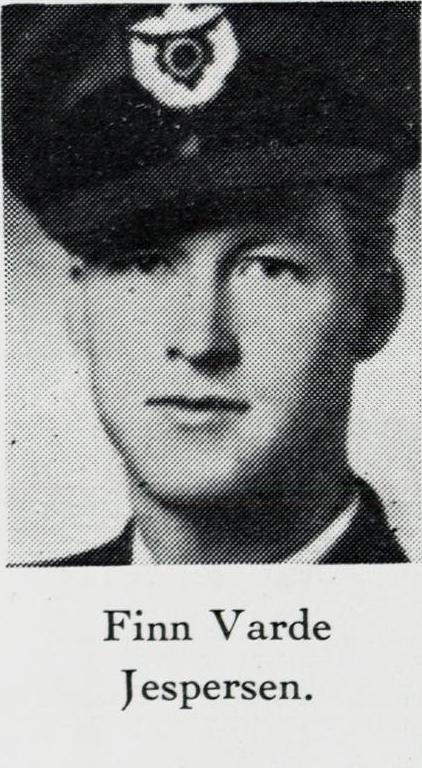
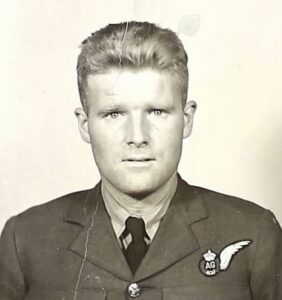
Lieutenant Finn Varde Jespersen, pilot. Commercial School, worked for the Philips engineering company before the war and was an orienteering champion. He served in the Royal Norwegian Army during the defence of Norway following the German invasion in the spring of 1940. He escaped from occupied Norway in the summer of 1940 via Finland, the Soviet Union and Japan (which was neutral at that time) and joined the Royal Norwegian Air Force in Canada. He served as an instructor and later in RAF Transport Command before transferring to Bomber Command. His diaries from his experiences in 1940 were edited and published in 1983.
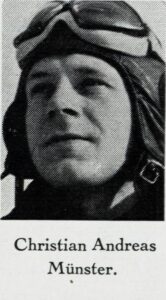
Sergeant Christian Andreas Münster, navigator. The son of a naval officer, he was a student at the technical university in Trondheim before the war.
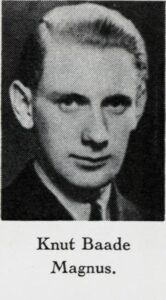
Sergeant Knut Baade Magnus, bomb aimer. Agricultural college. Joined the Royal Norwegian Air Force in the UK in 1941.
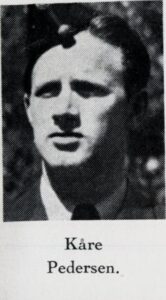
Sergeant Kåre Pedersen, wireless operator and air gunner. Technical school. Also qualified as an air mechanic.
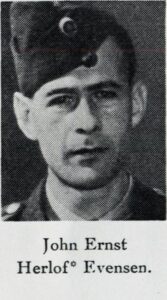
Sergeant John Ernst Evensen, rear gunner. Held an engineering degree from the Technical Institute in Gothenburg, Sweden. Was a member of the Norwegian Resistance and had to flee to Sweden (which was neutral) in 1941.
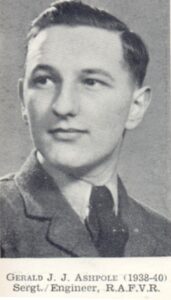
Gerald John James Ashpole, flight engineer. He left school in 1940 and worked at Martin’s Garage, Singlewell Road, Gravesend. He enlisted in the Royal Air Force Volunteer Reserves on the 17th May 1943.
William Robert McCutcheon, mid-upper gunner. He left school in 1934 and worked as a farmer for Judge Kelly for a year before buying his own farm. He enlisted in the RCAF on the 8th October 1943 and arrived in the UK on the 9th November 1943.
It is understood that the aircraft was shot down at c. 05.00hrs on D-Day, by Hauptmann Helmut Eberspächer of Luftwaffe’s I.Gruppe, Schnell-kampfgeschwader 10, 3. Staffel, who operated Focke-Wulf 190G night fighter-bombers out of Evreux. Eberspächer survived the war and corresponded with the Dutch aviation historian Theo Boiten. He is said to have been the first German pilot to have seen the Allied invasion fleet. His account is featured in Theo Boiten’s Night Airwar. Personal Recollections of the Conflict over Europe, 1939-45. Ramsbury: The Crowood Press, 1999. Eberspächer also wrote an article «Flugtag Juni 1944”, in Luftwaffen-Revue 1/95 in 1995. Here’s an extract, translated from German into English through Google Translate:
“(…) flying below a thin layer of cloud with the full moon shining above, suddenly there appeared above me and below the cloud layer the silhouettes of several Lancaster bombers looking like shapes projected on to a magic lantern screen. We were at war, the enemy had to be fought and I was in a good position for an attack. The Lancaster crews would hardly be able to see me as the ground was still in the dark. I was in a favourable position as I was able to see but could not be seen myself and I was able to fire from the dark into the light. And so I did, three times. Within minutes, three Lancasters caught fire, they fired back and hit my aircraft – but I did not notice that and only discovered it after my landing. Whether the Lancaster crews were able to save themselves with their parachutes or not I was unable to observe, but is is probable.” (p. 153)
Eberspächer’s sortie is also described in Steven J. Zaloga’s Smashing Hitler’s Guns. The Rangers at Pointe-du-Hoc. D-Day, 1944. Cumnor Hill: Osprey, 2022. However, according to informaiton provided by Theo Boiten, the kill was also claimed by Feldwebel Kurt Eisele of Eberspächer’s squadron. Eisele did not survive the war. Zaloga describes how Eberspächer first attacked and damaged Lancaster ND501, OF-Q. "Eberspächer continued his attack through the bomber stream, shooting down two Lancasters of 97 Squadron in the are around Isigny and Carentan. The entire engagement lasted only three minutes, from 0501 to 0504hrs. The next Lancaster attacked by Eberspächer was probably ND815/OF-G, which crashed near Osmanville on the eastern side of the Vire estuary.” (p. 130).
The next aircraft to be shot down was Lancaster ND739 OF-Z. The pilot, Wing Commander E. J. Carter, was last heard on the wireless at 0504hrs, when his transmission was interrupted mid-sentence. That ND739 was shot down, was witnessed by the rear gunner of another aircraft, Lancaster ND961/OF-N.
Zaloga describes how “The wreck of Carter’s aircraft was not discovered until 2010, when aviation archaeologist Tony Graves located an unidentified aircraft wreck in a marsh near Brucheville, a small French farming community on the western side of the Vire estuary about 2 miles northeast of Carentan and 15 miles from Pointe-du-Hoc. It was a short distance from the crash site of the Norwegian Lancaster shot down moments before. (…) Like many aircraft wrecks, the Lancaster disintegrated due to the violent, high-speed impact. The smashed debris was buried deep in the marshy ground, with few features such as the unit codes or serial number of the fuselage were shattered beyond all recognition. No bodies of the crew were discovered during the excavation. It was presumed that they had been located and buried by one of the local French communities, like so many others during the war, in graves marked simply as ‘unknown’.” (p. 132)
There were no survivors from ND815. Sgt. Gerald John James Ashpole (the British flight engineer) and an Unknown Norwegian Airman were found in the wreckage and buried in the local churchyard in Osmanville. The wreckage is said to have crashed in the garden of the local mayor and burned for several days.
The first Allied representative to arrive at the scene of the crash was an officer of the American Graves Registration Service. According to the RAF casualty file, he retrieved the identity discs, said that one airman was Norwegian and the other British, ordered the local population to carry out the burials and then left. After the war, the RAF corresponded with the Graves Registration Service in an attempt to retrieve the identity discs, but this proved unfruitful and they were not found. Here’s an original image of the original grave marker, from the records of the Norwegian War Graves Service.
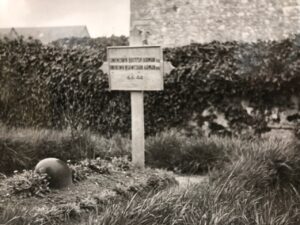
In the 1950s, the Norwegian War Graves Service conducted a number of missions to attempt to locate and identify fallen Norwegian airmen. Osmanville was visited by the dental surgeon of the Norwegian War Graves Service, Major John Braadvig, in 1950. He opened the grave and was able to identify Sgt. Ashpole on the basis of dental records. This was accepted by the RAF and his grave was subsequently rededicated and a CWGC headstone marking his name was installed. It was unfortunately not possible to identify the Norwegian; he was repatriated and is buried as an Unknown Norwegian Airman at Oslo’s Western Cemetery.
The Mid-Upper Gunner, F/O McCutcheon of the RCAF, and the Norwegian Rear Gunner, Sgt. Evensen, were found with a part of the port fin, and buried at Bayeux War Cemetery. They were both identified on the basis of the piece of the wreckage and uniform effects. Sgt. Evensen was repatriated to Norway in 1946 and is buried in Oslo’s Western Cemetery, being the only Norwegian crew member who is accounted for. As they were not buried in Osmanville but in Bayeux, it is surmised that they were not found with Sgt. Ashpole and the Unknown Norwegian Airman.
In 2014, to mark the 70th anniversary of D-Day, the Norwegian Armed Forces erected a Memorial to the crew, with all names inscribed, in front of St. Clement’s Church in Osmanville, with the attendance of the Chief of the Norwegian Defence Staff.
The Norwegian Armed Forces hold a ceremony there on D-Day each year. At the 80th anniversary in 2024, both the Norwegian Minister of Defence, the Chief of the Norwegian Defence Staff, and the Chief of the Norwegian Air Staff, were in attendance, as well as an honour guard from the Royal Norwegian Navy. Wreaths were laid at the memorial. The Senior Enlisted Leader of the RNAF, Command Sergeant Major Didrik Sand, laid a wreath on Sergeant Ashpole’s grave.
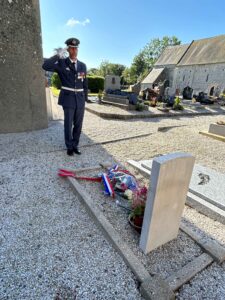
Photo credit: Mr. Ole Heintz of the Norwegian Armed Forces
The story of the Jespersen crew is quite well-known in Norway. There are relatively few RNAF crews that are still unaccounted for. The Norwegian War Graves Service has been reviewing and re-reviewing the case over a number of years. If anyone comes across any new information, then please let us know.
British Normandy Memorial - Additional Information
If you would like to find out more about Norwegain airmen in the Second World War, do listen to this fascinating podcast Episode 43 - Norwegian Heroes of Bomber Command, with Haakon Vinje
Amongst the topics of conversation are: The role of Norwegians in RAF Bomber Command; Understanding the Norwegian War Graves Service; The invasion of Norway and its Aftermath; the Norwegian Air Force and its contributions; Personal stories of Norwegian airmen; The story of Lancaster ND815 and D-Day; and The life and legacy of Nordal Grieg. (Nordal Grieg was a Norwegian poet, novelist, dramatist, journalist and political activist. He was a popular author and a controversial public figure. He served in World War II as a war correspondent and was killed while covering a bombing mission to Berlin.)
FALLEN HEROES
FINN VARDE JESPERSEN
Royal Air Force • LIEUTENANT
Royal Norwegian Air Force
97 (Straits Settlements) Squadron, Royal Air ForceDIED | 06 June 1944
AGE | 30
SERVICE NO. | N1205
CHRISTIAN ANDREAS MUNSTER
Royal Air Force • SERGENT
Royal Norwegian Air Force
97 (Straits Settlements) Squadron, Royal Air ForceDIED | 06 June 1944
AGE | 27
SERVICE NO. | N1747
KNUT BAADE MAGNUS
Royal Air Force • SERGENT
Royal Norwegian Air Force
97 (Straits Settlements) Squadron, Royal Air ForceDIED | 06 June 1944
AGE | 22
SERVICE NO. | N1960
KARE PEDERSEN
Royal Air Force • SERGENT
Royal Norwegian Air Force
97 (Straits Settlements) Squadron, Royal Air ForceDIED | 06 June 1944
AGE | 25
SERVICE NO. | N1745
JOHN ERNST HERLOF EVENSEN
Royal Air Force • SERGENT
Royal Norwegian Air Force
97 (Straits Settlements) Squadron, Royal Air ForceDIED | 06 June 1944
AGE | 28
SERVICE NO. | N5535
GERALD JOHN JAMES ASHPOLE
Royal Air Force • SERGEANT
Royal Air Force Volunteer Reserve
97 (Straits Settlements) Squadron, Royal Air ForceDIED | 06 June 1944
AGE | 18
SERVICE NO. | 1866432
WILLIAM ROBERT MCCUTCHEON
Royal Air Force • FLYING OFFICER
Royal Canadian Air Force
97 (Straits Settlements) Squadron, Royal Air ForceDIED | 06 June 1944
AGE |
SERVICE NO. | J/37150
FALLEN HEROES
FINN VARDE JESPERSEN
Royal Air Force • LIEUTENANT
Royal Norwegian Air Force
97 (Straits Settlements) Squadron, Royal Air ForceDIED | 06 June 1944
AGE | 30
SERVICE NO. | N1205
CHRISTIAN ANDREAS MUNSTER
Royal Air Force • SERGENT
Royal Norwegian Air Force
97 (Straits Settlements) Squadron, Royal Air ForceDIED | 06 June 1944
AGE | 27
SERVICE NO. | N1747
KNUT BAADE MAGNUS
Royal Air Force • SERGENT
Royal Norwegian Air Force
97 (Straits Settlements) Squadron, Royal Air ForceDIED | 06 June 1944
AGE | 22
SERVICE NO. | N1960
KARE PEDERSEN
Royal Air Force • SERGENT
Royal Norwegian Air Force
97 (Straits Settlements) Squadron, Royal Air ForceDIED | 06 June 1944
AGE | 25
SERVICE NO. | N1745
JOHN ERNST HERLOF EVENSEN
Royal Air Force • SERGENT
Royal Norwegian Air Force
97 (Straits Settlements) Squadron, Royal Air ForceDIED | 06 June 1944
AGE | 28
SERVICE NO. | N5535
GERALD JOHN JAMES ASHPOLE
Royal Air Force • SERGEANT
Royal Air Force Volunteer Reserve
97 (Straits Settlements) Squadron, Royal Air ForceDIED | 06 June 1944
AGE | 18
SERVICE NO. | 1866432
WILLIAM ROBERT MCCUTCHEON
Royal Air Force • FLYING OFFICER
Royal Canadian Air Force
97 (Straits Settlements) Squadron, Royal Air ForceDIED | 06 June 1944
AGE |
SERVICE NO. | J/37150
FEATURED SHOP ITEM
£25
ORDERStanding with Giants Puzzle
Bring a powerful moment of remembrance into your home with our Standing with Giants 500-piece jigsaw puzzle. Featuring the striking silhouettes installation at the British Normandy Memorial, this beautifully produced puzzle captures the scale and emotion of the tribute.
£22
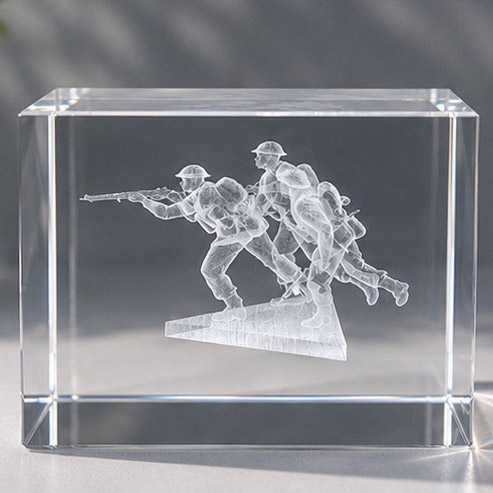
ORDERD-Day Sculpture Crystal Block
Laser-engraved within a solid crystal block, the detailed three-dimensional image can be viewed from different angles, creating a striking display piece.
£16.99
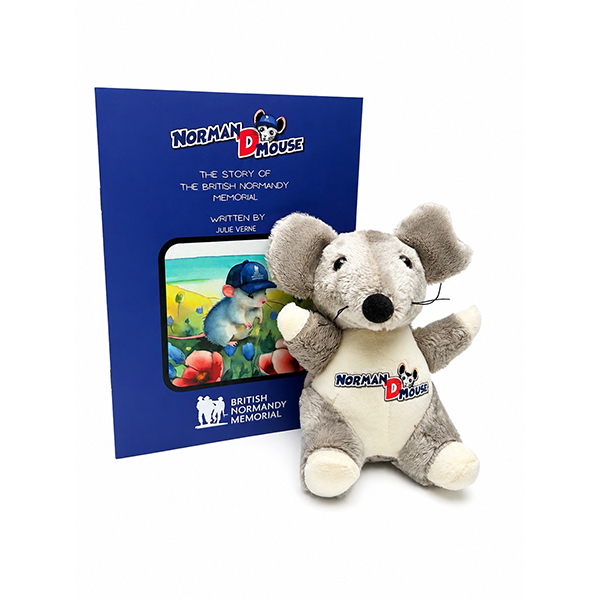
ORDERNorman D. Mouse & Book Gift Set
Meet Norman D. Mouse, the little mouse with a very big story to tell!