



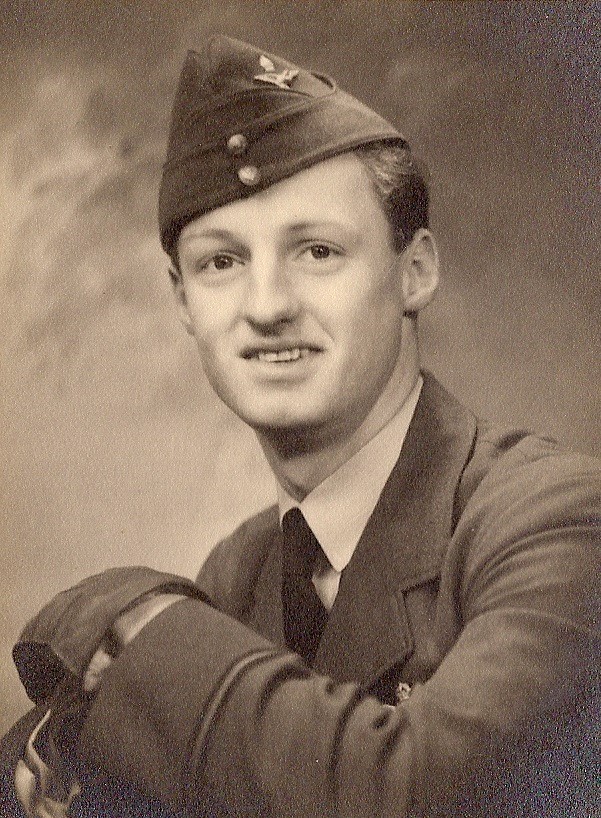
John Gordon Jannings
This story and photos are shared by the Trust with kind permission from John Hamblin, Researcher and Ian McLeod, nephew of John Jannings.
John Gordon Jannings, Flying Officer 151458, 76 Squadron, Royal Air Force. Killed in action on the 29th of June 1944, aged 21.
John Gordon Jannings was born in North London on the 8th of October 1922, the only son of Alfred Gordon Jannings, a company managing director, and Florence Kathleen Jannings (née Cripps) of 21, South Square, Hampstead Garden Suburb, London NW11. He was christened at Great Amwell in Hertfordshire on the 18th of November 1938 and he was educated at Haileybury College where he was in Edmonstone House from September 1936 to April 1939.
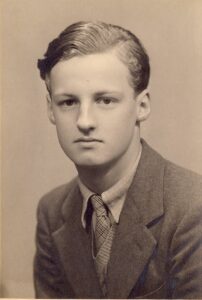
Photo of John, taken before he joined up
He enlisted in the Royal Air Force Volunteer Reserve where he trained as a pilot. His service record shows us that his first flight was taken at Elementary Flying Training School, Stoke Orchard in May 1942. He was then sent to Canada, on the troopship Letitia, to continue his training at #37 Service Flight Training School, De Winton, Alberta. He was one of the 130,000 air crew who participated in the BCAPT (British Commonwealth Air Training Plan) making it one of Canada’s greatest contribution to the war effort. This brought together recruits from the UK, Australia, New Zealand to the wide-open expanses of Canada to train. He rose to the rank of Leading Aircraftman before being commissioned in Calgary, Alberta as a Pilot Officer on the 5th of March 1943.
His letters home from Canada revealed that during his training which took him from British Columbia in the west to New Brunswick in the east he managed to visit New York, San Francisco and Vancouver. He mentions more than once how nice it was to see cities with streetlights blazing and the shops full of goods : such a contrast to the England he left behind with its black-out, barrage balloons and ration books. Whilst in Canada, he also took advantage of the opportunities to go skiing.
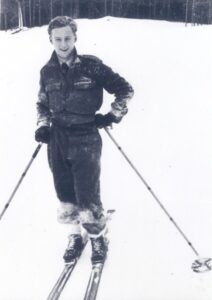
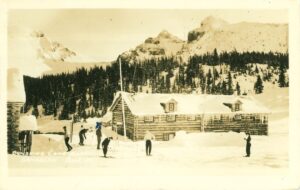
L-R: John Jannings out skiing; Sunshine Ski Resort, Alberta, British Columbia. The photo of John was on the top of his grandparents’ grand piano for eons so it was clearly their favourite shot of him.
We have photos of him in the Rockies at the Sunshine Ski Resort Alberta, British Columbia where he is pictured, below, with his Canadian girlfriend Doreen Davey. The photo that she sent him with the quizzical question "Remember Me?" suggests that she was hoping to see him again after the war. And we see his UK girlfriend Pamela Dixon at my Christening in early 1942 as he looks at her with a sideways glance. His face says it all! Again we have no photos or letters to say whether this relationship continued after he returned to the UK in September 1943. We can but hope that both ladies went on to enjoy long and happy lives.
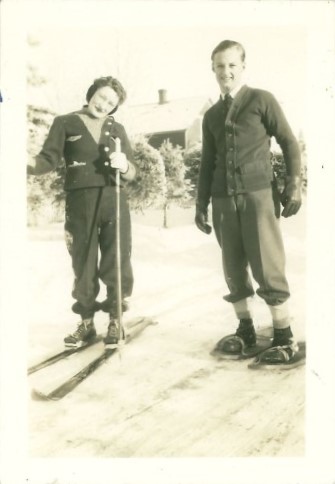
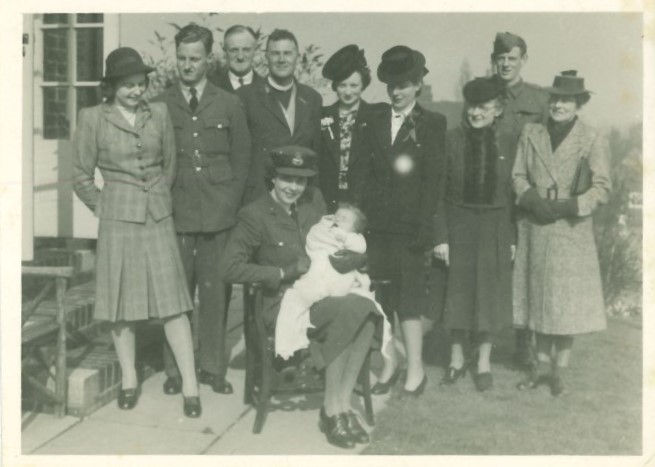
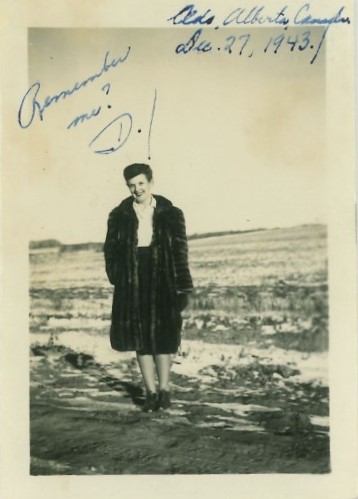
John with his girlfriends: L-R Doreen Davy with John in Canada; John, 2nd left at the christening of Ian with Pamela to his right; photo sent to John by Doreen, dated 27 December 1943
He returned to the UK on the Queen Elizabeth and was posted to #20 OTU Lossiemouth in September 1943 and he was promoted to Flying Officer on the 5th of September 1943. He carried out his first Dickie flight in January 1944. This flight was a mandatory training mission when an inexperienced pilot flew as a passenger with a veteran crew on a real bombing operation to give the pilot the chance to learn the ropes of combat flying before having his own crew. He then joined 76 Squadron in March 1944 where he completed 18 of the required 20 missions necessary to complete his first tour of duty. Many were in support of the Normandy landings, including on the night of 5th June when the target was Mont Fleury. He noted in his log book “memorable night, the invasion armada sailed beneath us, blackening the sea”
On the night of the 28th/29th of June 1944 Bomber Command dispatched 202 Halifaxes and 28 Lancasters, acting as Pathfinders, to attack the railway yards at Blainville-sur-Orne and at Metz in support of Allied ground operations following the invasion of Normandy. Both targets were hit by the attacking force.
John Jannings and his crew took off on their 19th mission from RAF Holme-on Spalding at 9.59pm on the 28th of June 1944 in Halifax Mk III MZ679 MP-C for the operation on Blainville-sur-Orne. However, their aircraft was attacked by a night fighter and crashed at Lesges, five kilometres to the south-south-west of Braine on the south side of the River Aisne in France with the loss of the entire crew who were: -
Flying Officer John Gordon Jannings (Pilot)
Sergeant Jack Edward Beeson (Flight Engineer)
Flight Sergeant Robert Logie Givens (Navigator)
Flying Officer Thomas Wellwood Thompson RCAF (Air Bomber)
Sergeant Colin Francis Poole (Wireless Operator/Air Gunner)
Sergeant Ronald Paul Lucas (Mid Upper Gunner)
Sergeant Burleigh Charles Acourt (Rear Gunner)
Theirs was one of twenty aircraft that were lost during the raids and one of three aircraft from the squadron lost that night.
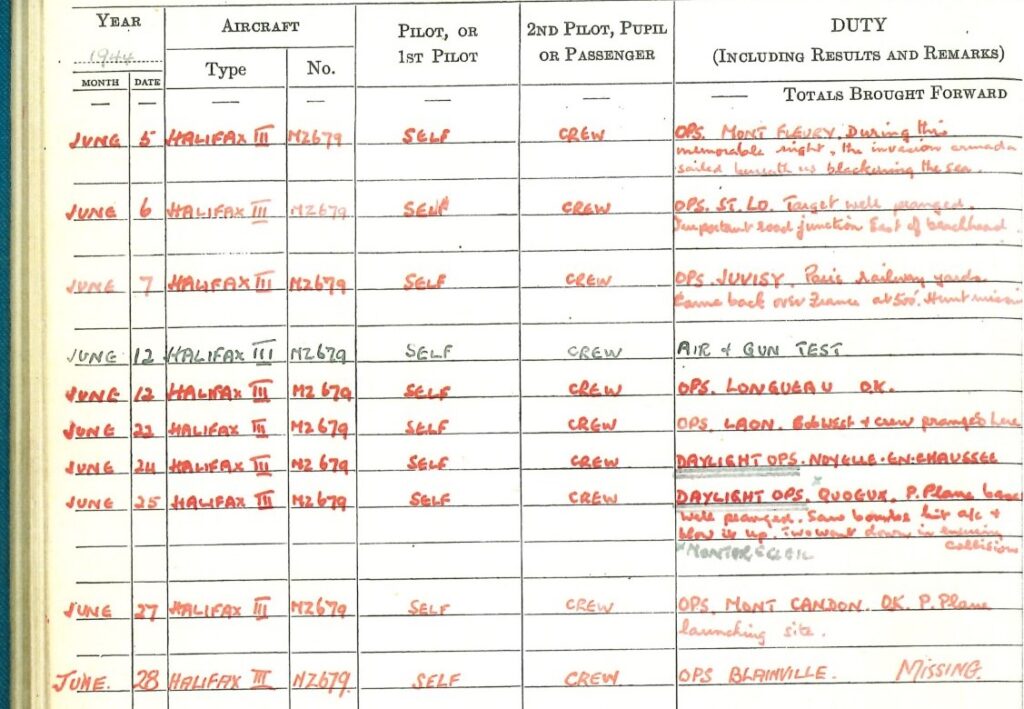
The last page in John Jannings’ log book where, in the final entry, he has been recorded as Missing
The station chaplain wrote to his parents the next day:
“The signal yesterday will have given you sad news that John went missing in an operational flight yesterday. It is such bad luck as he was near the end of his first tour of “ops”. Nevertheless, please have hope that all may yet be well. Our experience in the past has taught us that over 50% of missing personnel are later found to be safe. That may well be the case with him and his crew. You will hear nothing for a month or six weeks at least – and by then Air Ministry have usually hears something and notify you direct. For the anxious days ahead, may I remind you of what Tennyson said in regard to the power of prayer – they will sustain you as day succeeds day.”
John’s story is different to his crew’s because his body was not found until after the Germans had reported the deaths of his crew. As a result, he was posted as missing. The possibility that somehow he had escaped the fate of his crew by bailing out was totally nonsensical. But his family had to wait seven months for a final confirmation that he had died. I don’t think there was any doubt in anyone’s minds that he was dead, but I suppose “hope springs eternal”. A family friend, Major Emelyn Jones who was serving with 5 Bomb Disposal Company, Royal Engineers managed to find a way to visit Lesges soon after the Germans had withdrawn to find out more about his fate. After his visit he sent John’s parents this letter:
“After helping to keep the spark of hope alive during those unhappy days last July, I find it very difficult to write this letter, which must finally lay all our hopes to rest. At long last I have managed to get to Lesges. I was there yesterday and found John buried with his crew in the little village church. I also spoke to the villagers and learnt something of the details. I will try to give you some of them now, and perhaps may be able to add to when we meet again. At exactly midnight on the night of 28-29 June – it was a Wednesday night I think – John’s Halifax MZ679 came over in close combat with two Boche night fighters. Almost immediately the aircraft seemed to break up and crashed in about three different pieces, and the crew were all killed instantaneously. By the time the Germans arrived on the following morning, the villagers had found six of the crew – one of whom was still int the aircraft – but not John, who was lying in the corn about thirty yards away. That is why John’s death was not transmitted by the Germans – because they never knew of it. The others were buried on the Friday afternoon, and John was found on the Saturday morning. He was buried that afternoon – July 1st – and to both funerals the country folk for miles around gathered, bringing masses of flowers and setting the bells ringing in defiance of the German ban. There were no Germans present, and the mayor’s son was pathetically keen to say that no German had laid hands or eyes on John at all. The graves have been very well cared for. Seven neat white crosses have been made by the village people as follows:
J.G. Jannings 1585390
Sgt Beeson
Sgt Poole 1546962
Sgt Gavens (sic)
Sgt. Acourt (sic) 649091
Sgt Thompson
INCONNU (unknown)
John was identified from his name written on the inside pocket of his jacket. His rank is not yet on the cross because they didn’t understand the gradings of the R.A.F.
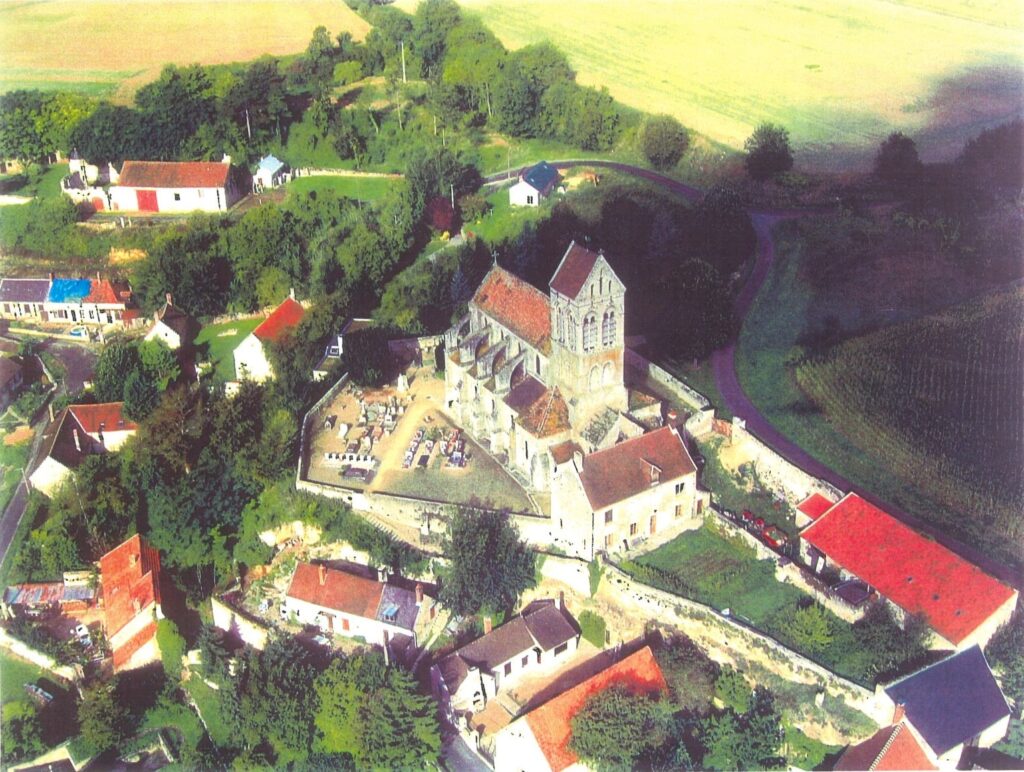
Lesges is a lovely little village of about 2 farms and a dozen or so cottages built round the picturesque XVIth Century church and set in a wooded hollow in the rolling uplands of Champagne. There then lie together in peace as in war a few yards from the spot where their last mission ended”
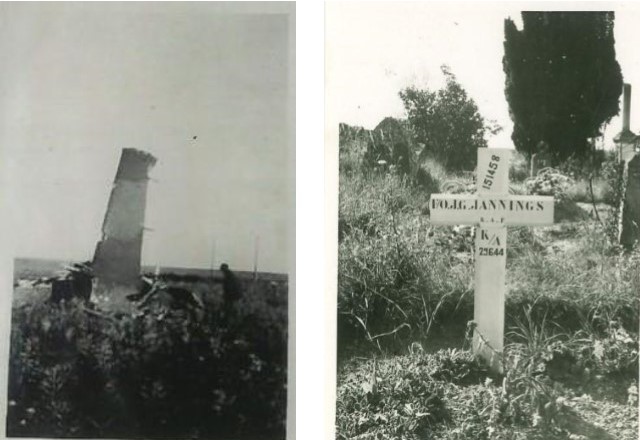
His parents were sent a photo of the aircraft wreckage, showing the tail section, as well as a photo of the temporary cross placed on his grave.
Shortly after Major Jones’ visit the Mayor of Lesges, Bernard Chauvin, who was one of three eyewitnesses to the crash, wrote the following letter:
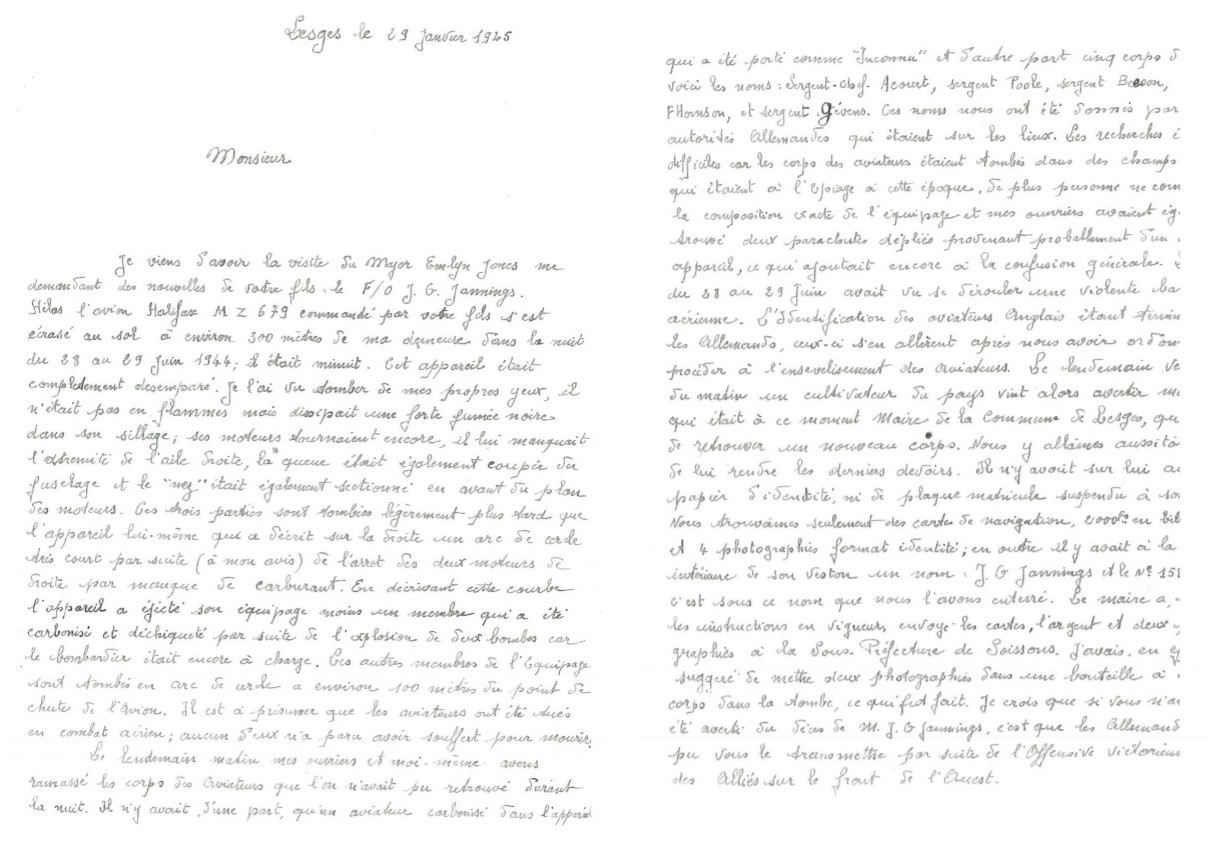
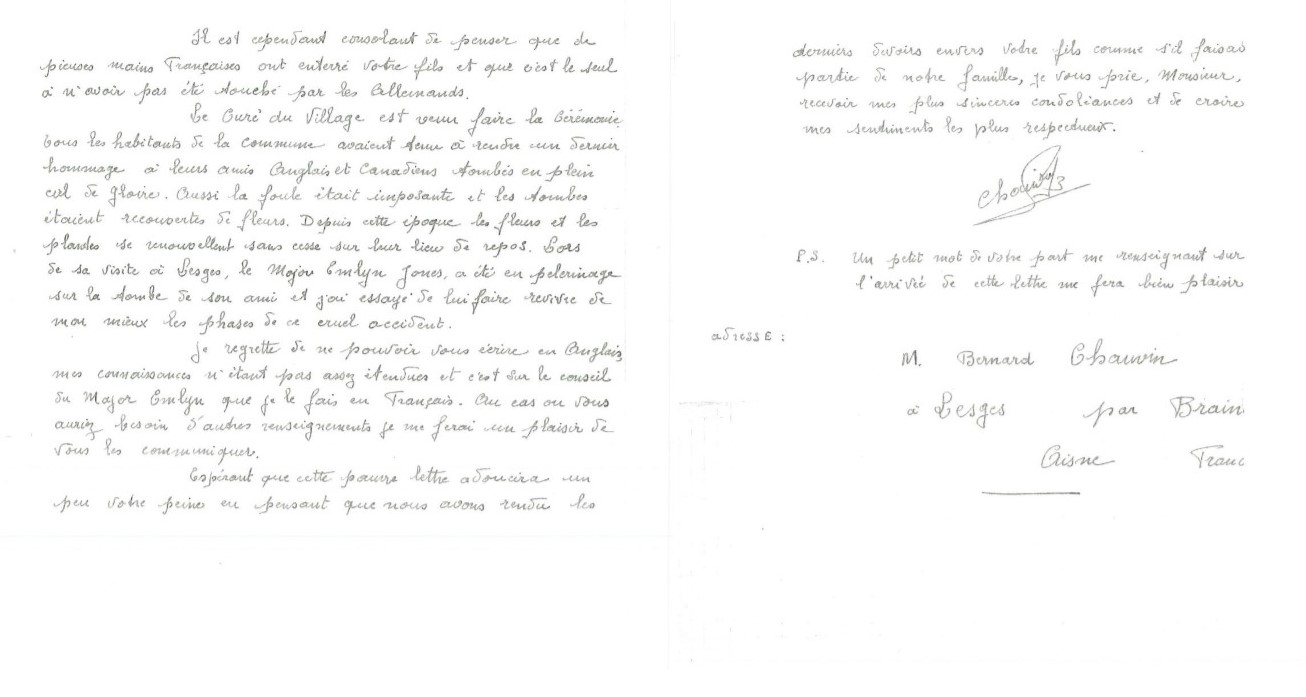
According to Ian’s daughter and husband, who translated it, some of the language is quite old. Some sections they weren't quite sure of and have marked those with a (?). Here is the translation below:
"Monsieur, I have just been visited by the Major Emlyn Jones who asked me about news regarding your son F/O J.G. Jannings. Alas, the Halifax plane MZ 679 commanded by your son, crashed to the ground about 300 meters from my house on the night of 28-29 June 1944; it was midnight. The machine was completely destroyed. I saw it fall with my very own eyes. It wasn't on fire but was emitting a black smoke trailing behind it. The engines were still going but it was missing the end of its right wing and the back wing was equally separated from the fuselage, and the nose was equally sectioned in advance of its motor (?). These three pieces fell slightly later from the body of the plane itself, which fell to the right in an arc very quickly (in my opinion), with 2 right engines stopping as there was no exhaust. In describing this scene (?), the crew were ejected from the plane with the exception of one member who was carbonised and shredded by 2 bombs that had been primed by the bombardier. The other members fell in an arc from 100 meters where the plane fell.. It is to be assumed that the pilots were killed in air combat. I doubt they suffered before they died. The next morning, the farm workers and myself collected the bodies of the crew that we couldn't find during the night. There wasn't any sign of the carbonised crewman, who is "Unknown", but the other names are Sergeant Major Acourt, Sergeant Poole, Sergeant Beeson, F Hounson (?), and Sergeant G. Evans (?), These names were given to us by Germans who were in the area. The investigation was difficult as the bodies of the crew fell in the fields which were in bloom (?) at that time, and no one knew the exact number of the crew. We found two unfurled parachutes, which added to the confusion on the night of the crash. The identification of the English pilots was completed (?) b
The identification of the English pilots was completed (?) by the Germans, which then permitted us to bury them (?) The next day, a farmer came along with the mayor of the village of Lesges, and found another body, who we then also gave last rights. He did not have any identification or dog tags. We only found navigation maps, 2000 in francs (?), and 4 ID photographs. In addition he had a vest on with the name J. G Jannings with the number 151 under his name, whom we buried. The maire gave firm instructions to give the maps, money, and 2 photos to take to the Prefecture of Soissons. I suggested to put 2 of the photos in a bottle to be buried with him, which the maire did.
I believe if you hadn't been advised about the death of J. G Jannings, the Germans would have soon been transmitting news of victory of the Allies on the Western front. It is consoling to know that it was pious French hands that buried your son, and not German hands. The priest of the village conducted a ceremony with the people of the village who together gave last respects to their English and Canadian friends who fell in a glorious manner. Also, there was a big crowd, and the graves were covered with flowers. Since this time, the flowers and plants continue to grow in their place of rest. During his visit to Lesges, Major Emlyn Jones who was on a pilgrimage to see the grave of his friend, spoke to me and tried to help him relive to the best of my ability the events of this cruel accident. I'm sorry I'm not able to write in English but my knowledge was not sufficient, but I share in French on the advice of Emlyn Jones. If you need more information it would be my pleasure to share it with you. I hope that this meagre letter assuages a bit of the pain knowing that we gave the last rights to your son like he was part of our family, and I give you my most sincere condolences and my deepest respects. ps. It would greatly please me if you could confirm receipt of the letter."
I have an aerial shot of the Church in whose graveyard the crew were buried. If you look carefully you can see the 7 white graves. This must have been taken in the 60’s or 70’s because the majority of the graveyard is now filled with the graves of the local citizenry. The blank area at the top right of the picture is where the plane actually crashed. In 1944 it was a cornfield and still was in 2006.
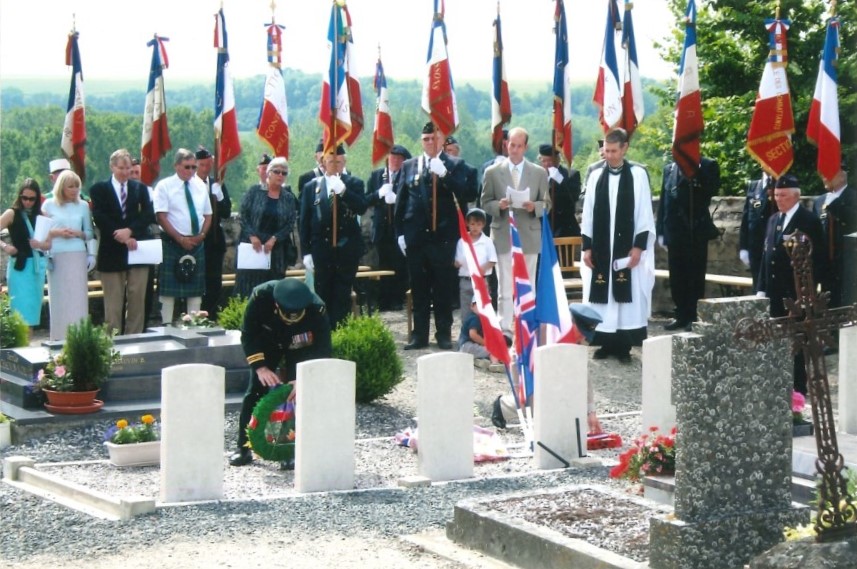
Since the end of the war crew members' families had left flowers at the graves but it wasn’t until the early 2000’s that Phillipe Chauvin, by then the Mayor, started to organize an official memorial event which finally took place on June 26, 2006. Tragically Phillipe died some six months before the event. His widow, Annique and their son, Jerome, the new Mayor took over responsibility and the event went off as perfectly as Phillipe had planned
It was attended by families of four of the crew; F/L Bert Kirkland, a contemporary of John’s who was on leave at the time of the raid; the military attaches from the UK and Canada; and an RAF padre. There was also a Guard of Honour from the French equivalent of the Legion with their flags who, I believe, were from Soissons.
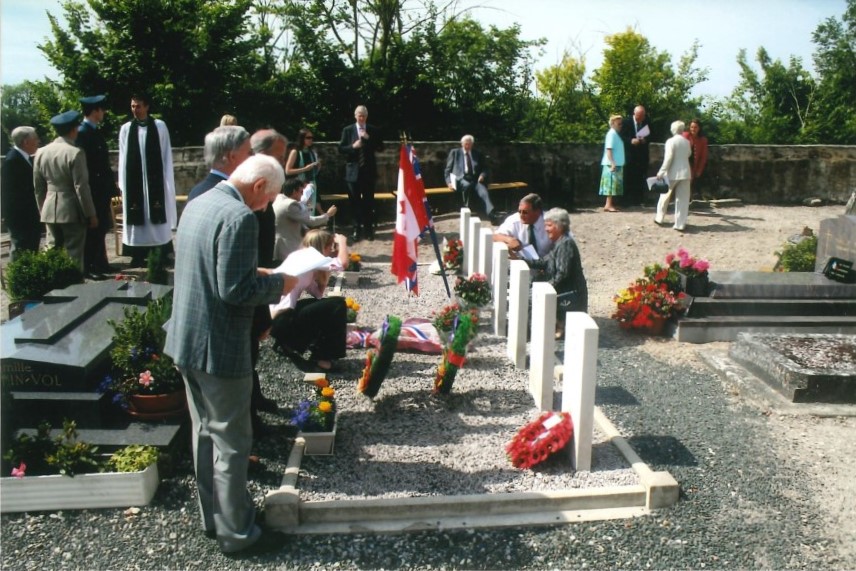
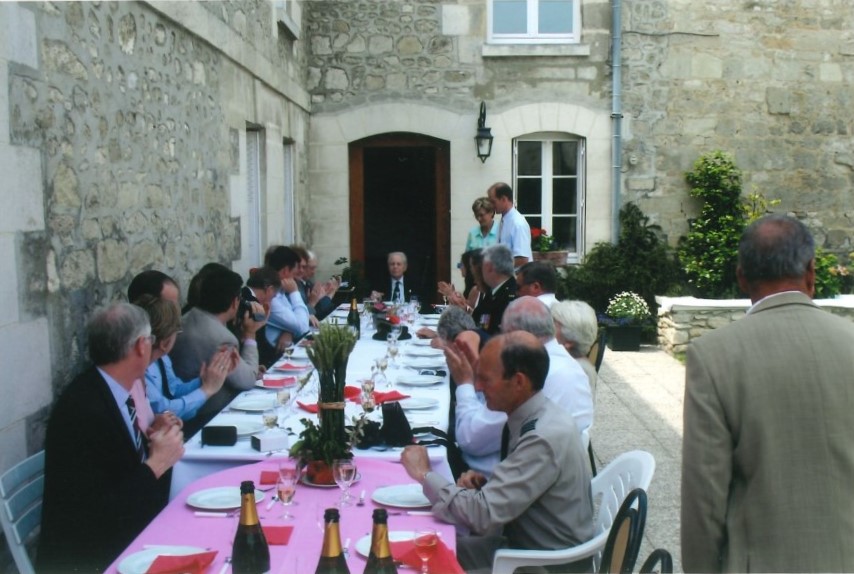
We had a magnificent meal after the ceremony and they even printed some 100 or so Orders of Service which on the day were too few to allow every guest to have one. I gave mine to a local citizen who was desperate to have a keepsake of what was the biggest event in Lesges since the war.
Many of the locals who attended the memorial service said John had purposefully kept the plane aloft for a few vital seconds to stop it hitting the village. Wishful thinking perhaps? Or maybe it was a noble and courageous act on his part. We shall never know of course. The families of the crew were able to speak with two eyewitnesses to the crash. They were young lads in 1944 but their recall was as if it happened yesterday.
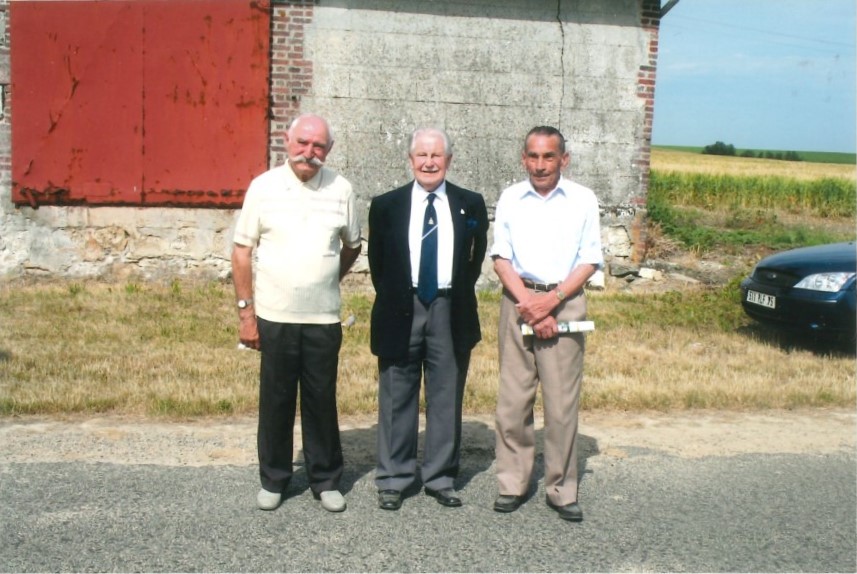
Two of the eyewitnesses to the crash of MZ679, Monsieur Soire and name unknown, standing either side of F/L Bert Kirkland

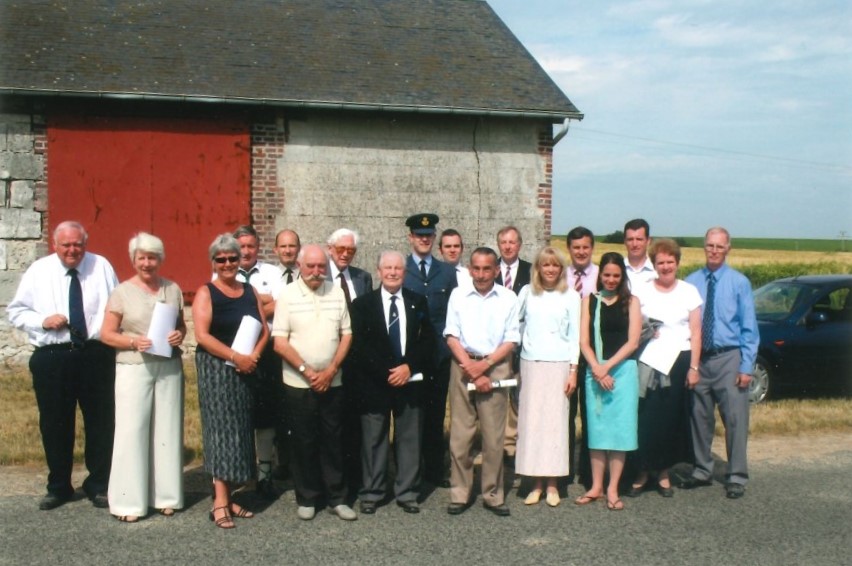
The families and friends visiting the crash site in 2006
I think it was quite fitting that the four families who attended represented England, Scotland, Wales and Canada.
As well as being commemorated on the British Normandy Memorial, John Jannings is commemorated on the war memorial at Haileybury College and on the memorial at Lloyd’s of London.
British Normandy Memorial - Additional Information
John Janning’s story was originally sent to us in February 2025 by John Hamblin but we did not have a photo of him until we were contacted by Ian McLeod, John’s nephew, who lives in Canada. As he explained in his email, his discovery of the story “had more to do with the price of property in Hampstead Garden Suburb than anything to do with any WW2 research that I might have been doing”.
It led to an exchange of many emails, as well as conversations about the respective weather in Canada and the UK, as he worked his way through the family archive to add more details to John’s story.
Having stumbled across John’s story on our website by accident, Ian hopes that maybe the families of John’s girlfriends might do the same and read this article and allow two more families to have a new family story to tell. If you are related to Doreen Davey or Pamela Dixon do get in touch and we will pass on your details to Ian.
FALLEN HEROES
JOHN GORDON JANNINGS
Royal Air Force • FLYING OFFICER
Royal Air Force Volunteer Reserve
76 Squadron, Royal Air ForceDIED | 29 June 1944
AGE | 21
SERVICE NO. | 151458
FALLEN HEROES
JOHN GORDON JANNINGS
Royal Air Force • FLYING OFFICER
Royal Air Force Volunteer Reserve
76 Squadron, Royal Air ForceDIED | 29 June 1944
AGE | 21
SERVICE NO. | 151458
FEATURED SHOP ITEM
£25
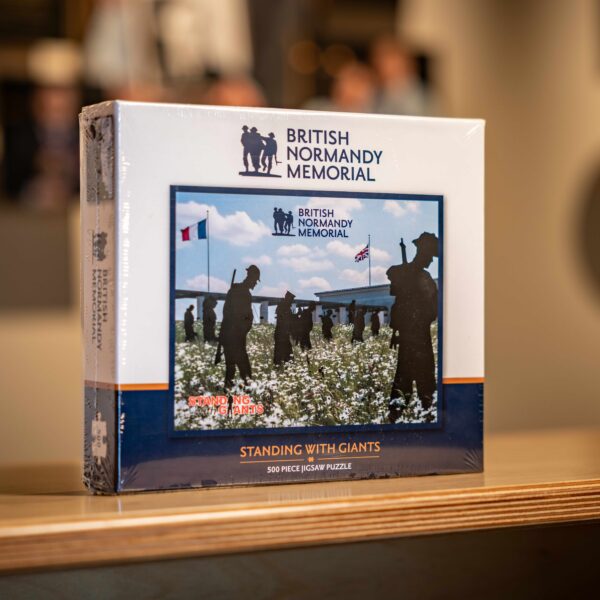
ORDERStanding with Giants Puzzle
Bring a powerful moment of remembrance into your home with our Standing with Giants 500-piece jigsaw puzzle. Featuring the striking silhouettes installation at the British Normandy Memorial, this beautifully produced puzzle captures the scale and emotion of the tribute.
£22
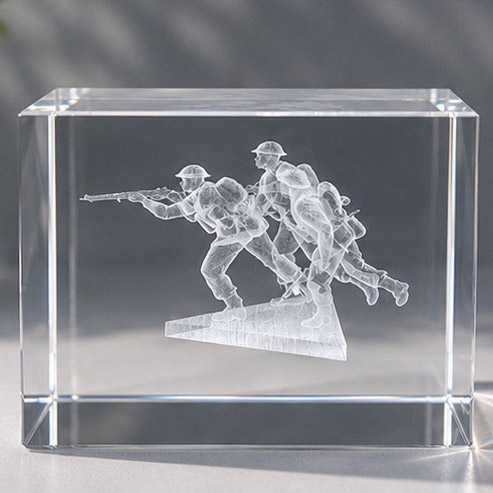
ORDERD-Day Sculpture Crystal Block
Laser-engraved within a solid crystal block, the detailed three-dimensional image can be viewed from different angles, creating a striking display piece.

£16.99
ORDERNorman D. Mouse & Book Gift Set
Meet Norman D. Mouse, the little mouse with a very big story to tell!