



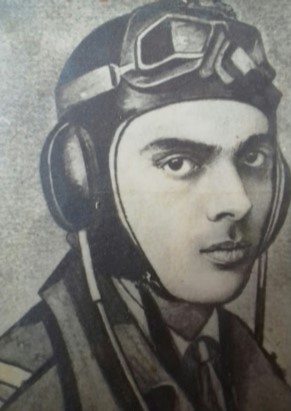
Mohand Singh
This story and photos are shared by the Trust with kind permission from Ali Chaudhry, Second World War Historian based in Dubai, United Arab Emirates. The portrait of Mohand Singh is shared by his nephew, Anil Sood.
Mohand (Mohan) Singh was born in the Punjab region of British India. In the late 1930s or early 1940s, he travelled to Britain for his education and was a medical student in London before the war. When World War II became more prominent, Singh put his studies aside and volunteered for the Royal Air Force Volunteer Reserve (RAFVR). Coming from the Commonwealth, he was among a small number of Indian nationals to serve in RAF Bomber Command during the war. Singh enlisted in the RAFVR in the early 1940s while in Britain, and he underwent aircrew training to serve as an air gunner. He proved to be an exceptional trainee and in 1943 he graduated at the top of his class in gunnery school and was one out of three men to pass with perfect scores.
The surname Singh and Punjab origin strongly indicate he was from a Sikh family and based on his education, it is likely he is from a family that values success. It was not uncommon for very well-educated Indian families in that era to send sons abroad for better studies. Enlistment was his own choice, as Indians were not forced to enlist in Britain. So, Mohand’s decision to join was likely due to a motivation for idealism or to fight fascism. His training would have taken place in wartime Britain. To cease his studies to enlist, Mohand must have felt quite strongly towards his cause.
106 Squadron was an RAF Bomber Command squadron equipped with Avro Lancaster heavy bombers and based at RAF Metheringham in Lincolnshire. Within a Lancaster seven-man crew, Sgt. Mohand’s position was the rear-gunner. This role involved controlling the four-gun tail turret to defend the aircraft against fighters of the night. Mohand joined up with a bomber crew in the 106 Squadron and began flying combat operations by late 1942. By the summer of 1944 he had completed 21 missions and was currently on his 22nd. Being a rear gunner, one of the most dangerous on the aircraft, the average missions survived for someone with this job was five. Mohand Singh survived more than four times the expected.
In 1943-1944, 106 Squadron participated in the intense bombing campaigns against Germany. Battles included the Battle of Berlin, in winter 1943-1944, as well as more sorties aiding the allied invasion of Europe. As part of No. 5 Group, Bomber Command, 106 Squadron duties ranged from very difficult, strategic raids over Germany to thought-out tactical strikes to help the D-Day missions. Weeks after the Normandy landings in June 1944, 106 Squadron was given the mission to bomb enemy positions in France. Missions included support of Operation Bluecoat in late July 1944 which targeted German strongpoints.
Mohand Singh flew aboard the Avro Lancaster Mk III bombers. His crew at this point was led by F/L Peter Lines, the pilot, with F/O Harry Reid, the navigator, F/O John H. Steele, the bomb aimer, Sgt Arthur W. Young, the wireless operator, Sgt Raymond Barnes, the flight engineer, Sgt John B. T. Davenport, the mid upper gunner, and Sgt Mohand Singh, the rear gunner, which completed the crew.
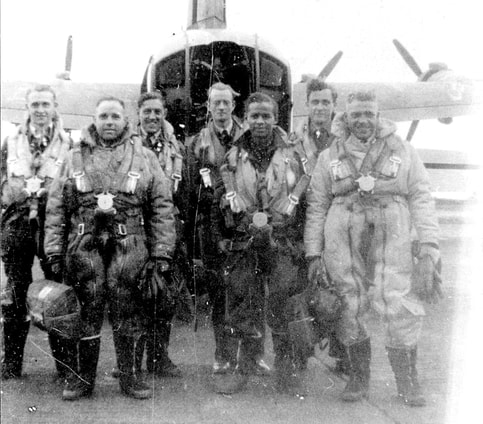
Crew of Avro Lancaster piloted by Flight Lieutenant Peter Lines. Mohand Singh stands at the end on the right.
A copy of this image is provided with the kind permission of Metheringham Airfield Visitor Centre
On the 30th of July 1944, the crew of Lancaster PB304 took off from RAF Metheringham in the early morning as a part of a larger formation of bombers.
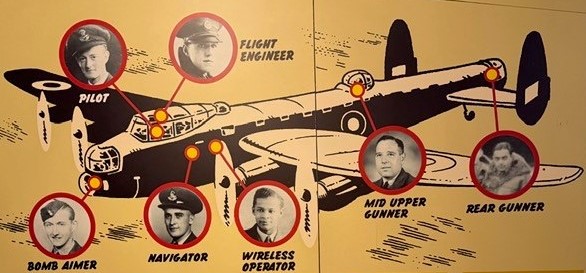
Crew of PB304
Top, L-R: Pilot - Peter Lines; Flight Engineer - Raymond Barnes
Bottom, L-R: Bomb Aimer - John Harvey Steel; Navigator - Harry Reid;
Wireless Operator - Arthur Wilmot Young; Mid Upper Gunner - John Bruce Thornley Davenport; Rear Gunner - Mohand Singh.
The briefing at 4am was miserable, with many men having been out the previous night in the heavy rain. The groups set off at 5:55am. Their target was German forces at Cahagnes in Normandy in support of Operation Bluecoat. However, the mission did not go as planned due to thick cloud covering the target area. This weather made bombing a target precisely almost impossible so the bomber force was forced to cease the attack and return to their base.
Many of the Lancasters headed back with their bomb loads still full. Communication and poor weather on the return flight forced the crew to take longer route home. This route was over the coast near Chester. The messages the crew were giving were misheard or misunderstood. Many of the other aircraft landed near Blackpool and eventually all the aircraft managed to land, either at home or away airfields. However, PB304 could not be contacted through their radio and they had not landed.
On the way back, Lancaster PB304 got into mishap. The aircraft sustained a lot of damage, likely from German anti-aircraft flak, which led to at least one malfunctioning engine and a fire. Witnesses saw the Lancaster flying low over Greater Manchester with its port engines sputtering and the airframe on fire. The pilot, Flight Lieutenant Lines, aimed for an emergency landing in an open field. Tragically, PB304 did not land well and at 10:10 the aircraft's wing struck the rooftops of houses on Regatta Street in Salford. The aircraft then landed in the River Irwell’s bank. A few seconds just after the impact, the fully loaded aircraft detonated in a huge explosion which hit the surrounding area and hurt around 70-100 people.
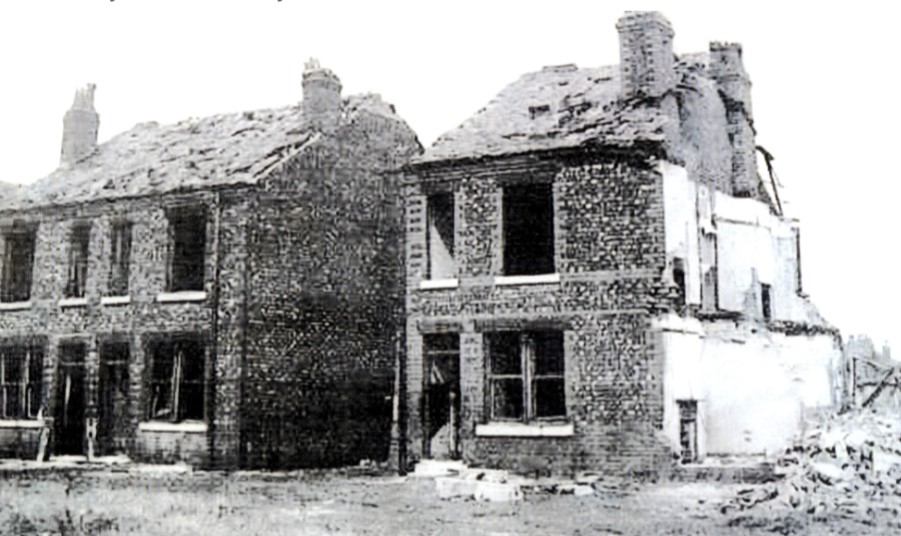
Damage to houses on Regatta Street, Salford caused by the explosion of Lancaster PB304
Two people on the ground were killed from the explosion, 45 year old George Morris and 72 year old Lucy Bamford. A third person, John Reeves, succumbed to his injuries 2 years later in 1946. Thanks to the pilot's effort to avoid a more populated area, the casualties were minimised, albeit a tragic incident. Reports mention it was heard ‘all over Manchester’.
Sgt Mohand Singh died in action on the 30th of July 1944, along with his entire crew. He was 30 years old being born around 1913-1914. Due to the insane force of the crash, not all remains could be gathered. Four of the crew were listed as not having a grave and are comemmorated in Runnymeade, Surrey on the Royal Air Force Memorial to the Missing. Three men however were identified and personally buried. F/O Harry Reid was buried in Kirkwall with his family, Sgt John B. T. Davenport in Sedgeley and Sgt Mohand Singh was cremated at Golders Green Crematorium in London. All seven members are remembered on a memorial at Agecroft cemetery in Salford.
Sgt Mohand Singh is one of the very few Indian nationals to serve in a RAF bomber command aircrew. In World War Two, many Indians served in the Royal Indian Air Force, (RIAF), in India/Burma or on ground roles, so it was quite rare to find an Indian volunteer flying missions with RAF bomber squadron in Europe. In 1940, only 24 Indians were selected for training in the RAF. Sgt Mohand Singh is respected in both India and Britain today for his bravery and service.
FALLEN HEROES
MOHAND SINGH
Royal Air Force • SERGEANT
Royal Air Force Volunteer Reserve
106 Squadron, Royal Air ForceDIED | 30 July 1944
AGE |
SERVICE NO. | 1324569
FALLEN HEROES
MOHAND SINGH
Royal Air Force • SERGEANT
Royal Air Force Volunteer Reserve
106 Squadron, Royal Air ForceDIED | 30 July 1944
AGE |
SERVICE NO. | 1324569
FEATURED SHOP ITEM
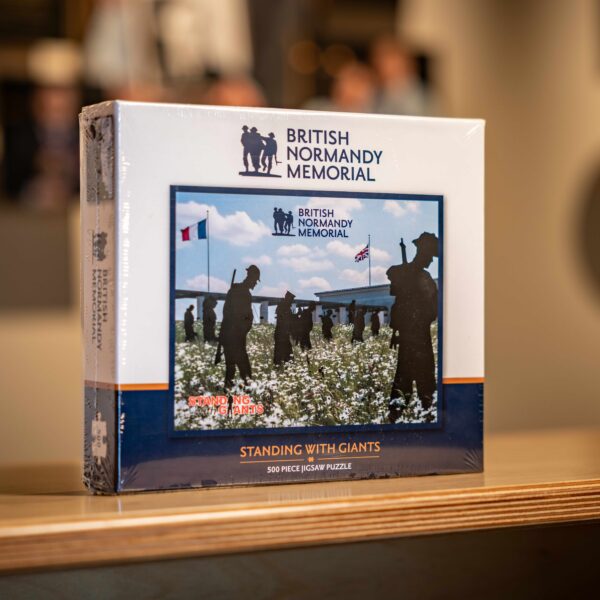
£25
ORDERStanding with Giants Puzzle
Bring a powerful moment of remembrance into your home with our Standing with Giants 500-piece jigsaw puzzle. Featuring the striking silhouettes installation at the British Normandy Memorial, this beautifully produced puzzle captures the scale and emotion of the tribute.
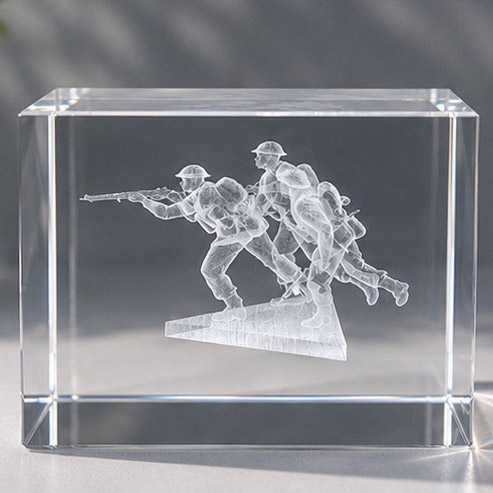
£22
ORDERD-Day Sculpture Crystal Block
Laser-engraved within a solid crystal block, the detailed three-dimensional image can be viewed from different angles, creating a striking display piece.

£16.99
ORDERNorman D. Mouse & Book Gift Set
Meet Norman D. Mouse, the little mouse with a very big story to tell!