




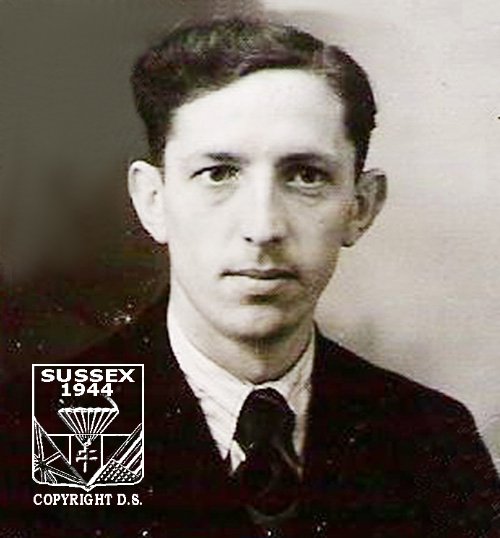
Georges Emile Muller #2
We first published the story of Georges Muller in November 2021 as part of the D-Day 75 commemorations. The story had only basic facts but his grandson, Hervé Junet-Muller, has been researching Georges’ story to discover what led him to pay the ultimate sacrifice in the Battle of Normandy. Herve came to talk with Henry Mongomery, during Henry’s journey around the UK and Normandy in 2026, about what he had found. Here is Georges’ story as told by Hervé.
Remembrance and the duty to contribute alongside the transmitters of remembrance, I devote a lot of time to it as a former soldier and president of an association of retired soldiers, but also and above all as the grandson of a "Died for France" fighter.
As a grandson, I have set myself the goal of retracing as faithfully as possible Georges' career as a resistance fighter and soldier, a career that has remained in the shadows for too long, and to honour his memory for posterity.
The story of Georges' journey was unfortunately not a story that I had been told by my grandmother, Georges’ wife, during the evenings by the fireside. Sure, I knew my grandmother, but only occasionally on short visits when I was a child. We were geographically distant from each other, as she had remarried and had 10 children with her second husband. As a result, I didn't have any special moments with her.
Georges-Émile Muller was born on March 6, 1915 in Mühlhausen, then under German administration. The only son of Émile Muller, originally from Baden-Württemberg (Germany), and Marie-Anne Judlin, from Soultz (Haut-Rhin), he grew up in a family of market gardeners with modest circumstances.
His birth occurred in the middle of the First World War and at the heart of the identity tensions that ran through Alsace. His parents made their union official on March 12, 1915 — six days after his birth — a gesture that reflected the social norms of the time. At that time a pregnancy outside marriage led to social rejection for single women. They were often marginalized and deprived of resources.
The Alsace of 1920 was a fertile ground for intra-family tensions. After 47 years of annexation, the families were often half-French, half-German in their culture. Some members felt deeply French. Others had grown up in German culture and preferred it. Some spoke mainly German, others mainly French. This could create disagreements about the child's education, the language to speak, the values to be transmitted.
On March 1, 1920, the couple separated for good. Georges was then raised mainly by his mother. The divorce, it is said, occurred in a climate of domestic violence, and Marie-Anne took sole responsibility for the young boy's education until 1924.
A diligent student, Georges obtained his school certificate in 1927, then his elementary certificates in Colmar in 1931 and his higher certificate in 1933. In the meantime, he worked in the family greengrocer's business in Mulhouse from 1932 onwards. He spoke fluent German, which would play a role in his future missions.
In March 1933, at the age of 18, he officially claimed French nationality, which he obtained when he was working as an office worker. There was high anxiety In Alsace over the strengthening Nazi regime in Germany and many residents feared the implications of the new German regime.
In October 1933 he anticipated being called up due to the political situation and he was eventually posted to the 6th Dragoon at Vincennes in October 1934. During his military service, he was appointed Brigadier, then he completed periods of reserve service and was appointed Maréchal des Logis (1st grade of the non-commissioned officer family) in the reserve.
After his military service, he returned to his parents' home until October 1936, when after passing the entrance exam, he joined the SNCF as a Facteur Mixte in Illfurth (10 km from Mulhouse where he worked in traffic control and commercial duties. He also met and married Marie Gabrielle Foerry on the 13th August 1936.
Georges progressed rapidly within the SNCF and by 1939 he was in Colmar-Nord where he held the position of Head of the Traffic Control Department of the SNCF. At the outbreak of war he was mobilised and he volunteered to join the country railways and was posted to the Metz depot (1 October 1939) and received the rank of Aspirant on 1 April 1940. He was posted to the narrow-gauge railways near Colmar on the banks of the Rhine. The sections of the Field Railways or technical sections of the Field Railways were military units, but they were not Regiments.
On the 17 June 1940, while he was in Montbéliard, the Germans arrived in the locality. He was taken prisoner on 18 June but on 20 June he escaped from the station with 4 comrades and they were able to return to Mulhouse and Colmar. Georges was demobilised on the 1st July 1940 and he resumed his work in Colmar for the SNCF.
His choices over the next few years were probably informed by what happened next. In 1940, Alsace was de facto annexed by Nazi Germany and subjected to a policy of accelerated Germanization. Young people lived in a climate of constraint, surveillance and humiliation. French was prohibited in schools and the school curriculum underwent Nazification. Compulsory recruitment of young people was introduced and families deemed “too French” were evicted.
However, many remained attached to France, out of loyalty to their family history, rejection of Nazification or refusal to be transformed into "perfect Germans". In this context, choosing France means choosing freedom and asserting an identity that the occupier seeks to erase.
He approached the Chief Inspector in Paris and asked to leave Alsace, which was now de facto annexed to Germany. He was told that he was considered a bad patriot and to reach France one had to be dismissed from the railways or expelled from Alsace. An opportunity arose on October 29, 1940, when he was asked to sign a membership in favour of the Germans. He refused, which led to his dismissal on the morning of October 30.
He was the only one to refuse and was reported to the Gestapo as a public danger.
On November 21, 1940, four Gestapo agents came to pick him up with his wife and five children. They had to leave everything behind as they were only allowed to take a few belongings and some savings. They taken in a van to the train station where they found about twenty Alsatians who were being expelled like them and were sent in direction of Lyon.
He was posted to Lyon-Brotteaux between November 1940 and September 1942 where he worked as an executive at the SNCF. This gave him more freedom of movement than others. He decided to join the Resistance and the LibérationSud movement in September 1941. He was put in charge of propaganda, particularly in railway circles, and the printing and distribution of the clandestine newspaper. He was in contact with local intelligence networks and was involved in the manufacture of false papers and exfiltration of resistance fighters.
Georges’ wife also took risks as she sheltered resistance fighters. On the 4th April 1942 Georges was appointed head of propaganda and broadcasting for the Liberation group in Lyon and in June he was asked to deal with sabotage in the railways. He was given two pumps which he gave to two railway workers. The pumps had been sent from England and were used to inject an oil and abrasive powder mixture into the axel boxes of the wagons carrying war material. The train would depart as normal from the depot but after 20 or 30 kilometres, under the effect of the speed, the abrasive powder heated the bearings until they melted. The axle would break causing the carriages to derail which blocked the main lines for days.
But in September 1942 Georges was reported to the French police and was under surveillance by the Gestapo. Georges realised he had to escape so, on the 23rd April 1943, he set off via Spain to reach the Free French forces in North Africa. He was arrested and briefly imprisoned by the Francoist authorities in Albana on 24 April and spent time in camps at Figueres, Girona, Barcelona, and finally in Miranda. He was freed on the 26th August 1943 and on the 21st October 1943 embarked the on the Sidi Brahim for Casablanca.
He was sent to the Mediouna camp in Morocco on the 23 October 1943 and was initially posted to the 19th Engineer Regiment with the rank of Aspirant. When he arrived in Algiers on the 8th November and was posted to the BCRA (Central Bureau of Intelligence and Action), the intelligence service of Free France. He reached London by January 1944 and was spotted by MI6. In his interrogation report he was described as "very intelligent, conscientious, hard-working and devoted, German-speaking".
On January 7, 1944 he signed his FFL/BCRA enlistment form No. 1275 and officially enlisted in the Free French Forces. He undertook commando/secret agent training at Glenalmond School before accepting a clandestine mission in occupied France. He had been recruited to the Sussex Teams, a Franco-British intelligence network. He was temporarily promoted to the rank of 2nd Lieutenant in the Engineer Corps under the alias Gaston Marchand, effective June 1, 1944, by decision No. 26 dated June 24, 1944, issued by General Koenig, Commander-in-Chief of the French Forces in Great Britain.
He parachuted into France on 6 July 1944 near Fouilleuse (Soissons sector). His radio operator was Théodore Réfranche (alias Raymond Thenet). Their mission, codenamed Operation Murat, was to radio back vital strategic information, including German troop movements, to Allied headquarters in Britain to inform commanders’ decisions, planning and deployments.
There were some difficulties in radio links which limited transmission of intelligence at first. But with the local liberation he made contact with the American troops, in particular Staff Sergeant John William Callif, a front-line investigator (follow the retreating enemy as closely as possible) within the 1staff Counter Intelligence). It was believed he probably handed over documents classified as "SECRET" to the Allied forces.
On 31 August 1944, during an operation/intelligence outside Soissons, Georges Muller and Lieutenant Raymond Devillers were captured and executed in what became known as the massacre of the Bois des Châssis (Retreating German forces used a captured American soldier's uniform to lure French Resistance fighters into a trap on the RN 31, leading to the murder of civilians and soldiers.) A report and local notices indicate he was executed after interrogation and discovery of documents on him.
Personally, referring to the epitaph accompanying Georges' original story on the British Normandy Memorial website, "A patriotic Frenchman who served in British units will now be remembered for generations to come at the site where – thanks to his sacrifice – France became free again", I can only thank from the bottom of my heart all the protagonists who worked to do justice to a life marked by courageous choices for freedom and so that the memory of Georges Émile Muller alias Gaston Marchand lives on.
British Normandy Memorial – Additional Information
Alsace-Lorraine, a region bordering France and Germany, has a complex history defined by centuries of territorial disputes between the two nations. This caused profound impacts on its population and identity. The region is characterized by a mix of German and French cultural elements, with a population that historically spoke both languages. Formerly under German rule as part of the Holy Roman Empire, it was largely absorbed by France by 1766. Following the 1871 Franco-Prussian War, it became a German territory but was returned to France after WWI with the Treaty of Versailles in 1919. It was then annexed by Nazi Germany in 1940 and approximately 130,000 local men, known as the Malgré-nous ("Against our will"), were forcibly conscripted into the German Wehrmacht. With the defeat of German in 1945 it returned to France and has remained with France since 1945.
FALLEN HEROES
GEORGES EMILE MULLER
Special Agent • CAPTAIN
Sussex Teams
Sussex Mission MuratDIED | 31 August 1944
AGE | 29
SERVICE NO. | 54
FALLEN HEROES
GEORGES EMILE MULLER
Special Agent • CAPTAIN
Sussex Teams
Sussex Mission MuratDIED | 31 August 1944
AGE | 29
SERVICE NO. | 54
FEATURED SHOP ITEM
£25
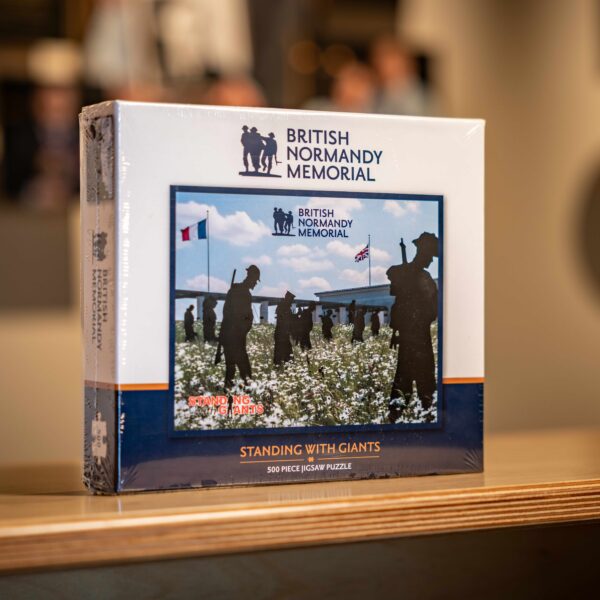
ORDERStanding with Giants Puzzle
Bring a powerful moment of remembrance into your home with our Standing with Giants 500-piece jigsaw puzzle. Featuring the striking silhouettes installation at the British Normandy Memorial, this beautifully produced puzzle captures the scale and emotion of the tribute.
£22
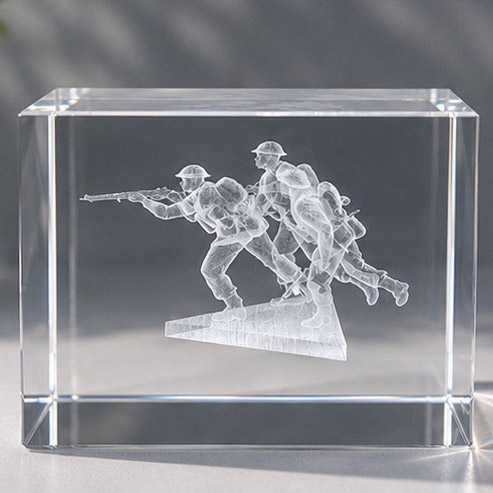
ORDERD-Day Sculpture Crystal Block
Laser-engraved within a solid crystal block, the detailed three-dimensional image can be viewed from different angles, creating a striking display piece.
£16.99
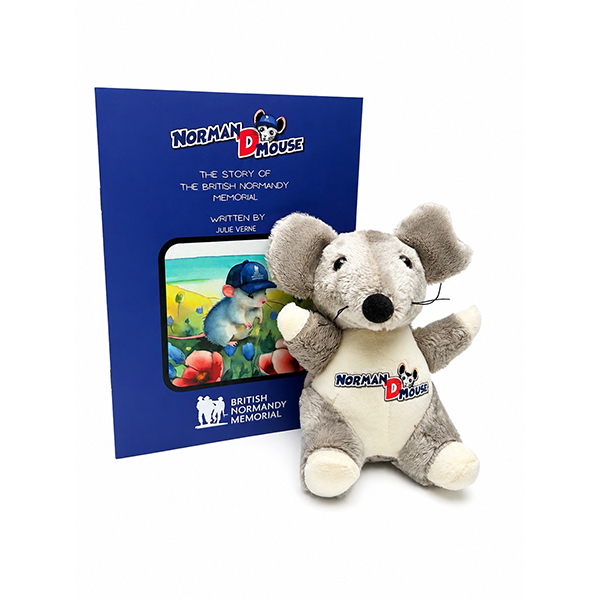
ORDERNorman D. Mouse & Book Gift Set
Meet Norman D. Mouse, the little mouse with a very big story to tell!