



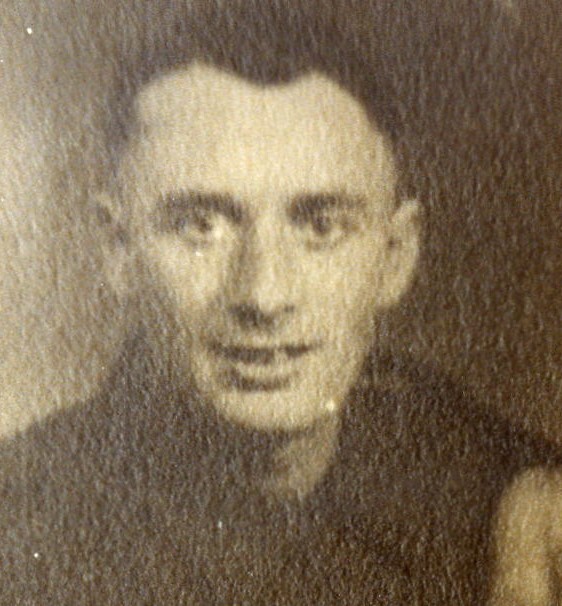
William 'Bill' Richardson
This story and photos are shared by the Trust with kind permission from John Slight, nephew of William Richardson.
William (“Bill”) Richardson was born on the 20th September 1918 in the village of Trimdon Grange, County Durham. He was the second son of Samuel and Annie Richardson (née Carvil). Samuel was a miner (coal hewer) at the local Trimdon Grange colliery, his family having lived in Durham since the 1830s although they originated from the Wigton area of Cumberland. Annie was born in Cleator Moor, near Whitehaven in Cumberland but her parents originally came from Kircubbin in Ulster, having moved to Cumberland around 1880. These links to Cumberland may well have had some bearing on the regiment which Bill joined in 1939.
Although Bill was Sam and Annie’s second son, he was in fact their sixth child. Five more children were to follow the birth of Bill. He eventually had seven sisters and three brothers. Apparently, life was quite tough during the 1920s, especially after the temporary closure of the colliery in 1925. In the early 1930s, the family was apparently means tested which resulted in those members of the family not already married or working away from home in other parts of the country, having to move to Leicestershire to find work. They settled in the village of Whetstone near Leicester where they lived in “Brickyard cottages”, on the Cambridge Road. The family still had relatives living in Trimdon and Cleator Moor and therefore visited them occasionally.
I assume that Bill started work as a general labourer at the age of fourteen, which would have been in 1932, as my mother also started work at that age, although she, like some of her sisters, was sent into “Service” i.e. as a housemaid, in other parts of the country.
In 1939, it appears that Bill may have been living with relatives and working in Cumberland, as his service record indicates that on enlistment on the 15th September, he gave his address as “Low Lodge, Cleator, Cumberland”. He joined the Border Regiment and underwent basic training at the Border Regiment Infantry Training Centre following which he was posted to the 5th (Territorial) Battalion on the 17th January 1940 as, on the 15th January, the 42nd Division, including 5th Border and 126th Brigade had moved to southern England to make its final preparations before joining the British Expeditionary Force (B.E.F). The men of 5th Battalion entrained on the night of 15 January at Acklington, Northumberland for Swindon, Wiltshire. Despite the severe weather conditions and poor driving conditions on the roads the battalion's transport moved by road. After the 42nd Division's arrival at Swindon the preparations for overseas service continued.
It may have been not long after this that Bill became the batman to Lieutenant G. Hewetson who had been appointed as Battalion Adjutant. Lieutenant Hewetson had been a teacher in Cumberland prior to volunteering for the Territorials when the war started.
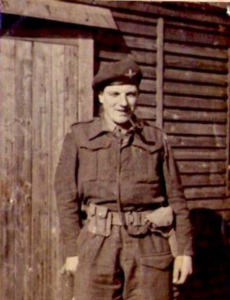
Lt Col George Hewetson
The 5th Battalion was a 1st line Territorial Army unit that was serving with the 42nd East Lancashire Infantry Division and was sent to join the British Expeditionary Force in France in April 1940. The Regiment's transport left the Swindon area fully loaded on the 8th of April 1940 while the officers and men entrained for Southampton on the 16th of April 1940. Embarkation took place the following day and the battalion set sail for France as part of the B.E.F. But their time in France would not be for long. On the 29th May they were ordered to withdraw to Dunkirk and on the 31st of May they received the order for all men not urgently required to withdraw to the beaches. They did so on the night of the 1st of June and some of the battalion was taken off the beaches. The remaining men went to the mole for embarkation. This last party of men disembarked at various ports on the southern English coast and the 5th Border survivors were eventually re-united at Spennymore, Yorkshire. Bill’s service record shows that he served in France from the 18th of April to the 5th of June 1940. My mother always said that he returned from France with, “…only the clothes that he stood up in”. Whether he was unable to bring his kit i.e. webbing, pack etc. and rifle back to England, I’m afraid that I don’t know. Maybe he was one of those taken off the beach, rather than the mole.
After returning from Dunkirk, they went on home defence until September 1941. During this period, on the 8th November 1940, Bill was awarded 28 days detention by his battalion commander, the charge being, “When on active service being in improper possession of one H.M.V. Gramophone, one record case and 31 records”!
It was decided to convert the 42nd Division into an armoured division due to a shortage of armoured troops and the division became the 42nd Armoured Division with the 5th Border becoming 110th Regiment, Royal Armoured Corps (R.A.C.), 126th Brigade. Bill’s service record shows that he was transferred on the 1st of November 1941. In May 1942, 126th Brigade was withdrawn from the 42nd Division. It became the 11th Independent Tank Brigade.
It was at this time that Bill probably met his wife-to-be, Phyllis. She was living in Plymouth in 1939 but had obviously moved to Yorkshire, possibly because of the numerous bombing raids that had taken place on the city, or maybe because she was involved in some sort of war work in the area. Whatever the reason, on the 8th of September 1942, she married Bill in Skipton, some 30 miles from Castle Bolton. They subsequently had a son, Denis, who was born in Skipton during the summer of 1943.
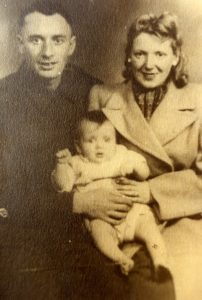
Bill, Denis and Phyllis in 1943
In December 1943 the 110th Regiment R.A.C. was disbanded but prior to this, on the 27th of October 1943, Bill transferred to the Army Air Corps with Major George Hewetson, as he was serving as his batman. Lieutenant George Hewetson had risen to the rank of Major and commanded a squadron of tanks. He apparently persuaded a number of his fellow battalion members to volunteer for the Parachute Regiment and I daresay that Bill didn’t have to give it too much consideration, having served with Major Hewetson for some four years or so. Bill qualified as a military parachutist on course 93, which ran at RAF Ringway from the 29th November to 13th of December 1943. The course notes record that he was: 'Good. Keen but lacking a little in control.' He then joined the 8th Parachute Battalion on the 14th of December 1943 and continued to act as batman to Major Hewetson.
In the months leading up to D-day, the 8th Battalion were billeted at Tilshead camp, on Salisbury Plain. Training was intense. For example, it was necessary for each man to be able to march 50 miles in 24 hours in full service order, carrying all weapons and then still be fit to fight. One such training exercise saw ‘C Company’ leave Tilshead at 15:00 hrs, resting for 5 minutes every hour, then 15 minutes after 3 hours. A longer rest of 2 hours was allowed at Codford (about 10 miles from Tilshead at 07:30 hrs the next morning), then they continued the march, returning to the camp and marching at attention at 12:50 hrs.
Several exercises involving parachute drops also took place, along with weapon training, including familiarity with German weapons, physical exercise and drill. It was also necessary for every man to be able to operate a wireless set and from the rank of Corporal upwards, to be able to signal and direct aircraft to drop zones.
Presumably Phyllis and baby Denis moved from Skipton at some point in late 1943 or early 1944. I would think that Bill was able to take some leave during this period and was able to spend some time with his wife and son. On his service record, Bill’s “Next of kin” is initially shown as his father, Samuel but he died in 1941 in Leicester and Phyllis is then shown as his next of kin. There are two other addresses shown: the first is Brickyard Cottage, Cambridge Road, Whetstone and the last is 66 Alvington Street, Plymouth. My eldest sister who was born in 1940 and lived at Brickyard Cottages has a vague recollection of Bill visiting the family home and possibly Phyllis and Denis being there. Whether Phyllis lived there for a while before returning to Plymouth, I don’t know. Maybe she rejoined her family following Bill’s death?
And so, to D-Day…
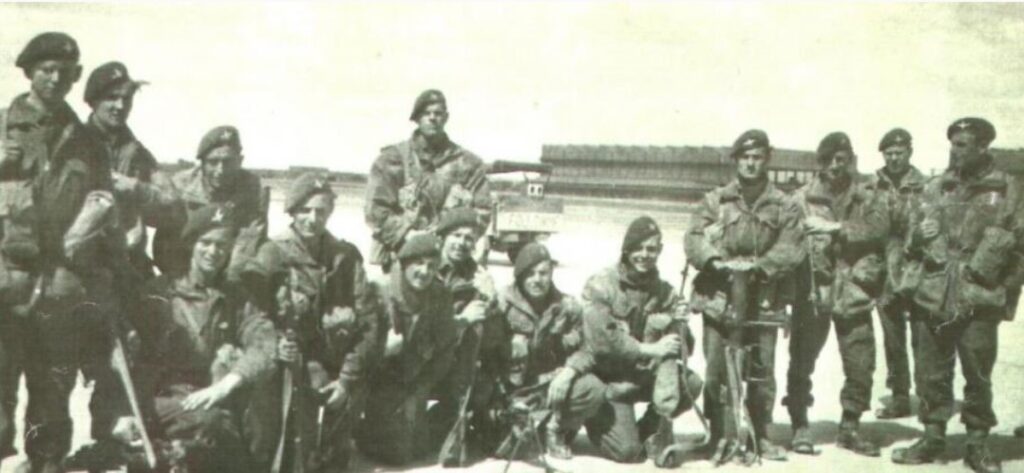
8 Para Group pre-D-Day 1944
On D-1 the Battalion moved from Blakewell Farm Airfield Transit Camp to Blakehill Farm Airfield. The aircraft towing gliders took off first at 22:40 and were then followed at 23:11 by aircraft of A' Flight 271 Squadron.
The 271 Squadron Operation Record Book [AIR 27/1574] states:
“A” Flight (Detached at Blakehill Farm). 10 crews were detailed to drop paratroops on Toufreville to protect the left flank of the British 2nd Army landing on the beaches. In addition to dropping paratroops, 20 lb bombs were dropped on the coast to interfere with coastal defences. According to the crews (sic) report all paratroops were dropped successfully on the DZ. All aircraft returned safely to base, but three received slight damage by flak.
They were carrying the parachutists of A Company, C Company, Battalion HQ "B" Party of the 8th Battalion and Lt. Marquis and his Royal Army Medical Corps stick (224th Parachute Field Ambulance).
But the Station's Medical Officer report for the Month of June [1944] from RAF Station Record Book Blakehill Farm [AIR 28/86] reports: 6.6.44 Only 1 plane had any casualties and that was a dead paratrooper who had been hit by S.A.A. (small arms ammunition) before he jumped from the plane. No planes lost.
That paratrooper was my uncle, Bill Richardson. Details of his death can be found in an account by one of his comrades, Pte John Russell, whose recollections of the 8th Parachute Battalion and the Normandy campaign were related in a series of letters to various comrades. Pte Russell was with him in the Dakota taking them to Normandy.
"Private Richardson was Major Hewetson's batman & was seated No.2 on the starboard side opposite the open "door". I believe No.4 was Private Cooper (all kit-bag men were seated near the exit.)
It was dark there when we boarded & very little was spoken on the flight (by anyone!). I was No.6. C.Q.M.S. Peters (No.20) came along during the flight, to Pte Donovan who was having problems with his kit-bag; I believe he was No.7 (he was slightly forward of me in the aircraft, not opposite). We approached the French coast - I could see what looked like the Le Havre peninsular & the R. Seine mouth (looking past No.4 & the "door" opening).
A bloke, perhaps No.9, suddenly asked, "What are those flashes?" Someone answered, "Flak." Silence. Then came a tremendous "crack" like a greatly magnified rifle bullet going past. (I presumed it was an 88 shell passing.) Exploding shells could be heard, but their "Karumph"s seemed some distance away - then came a much closer "Karumph" & shortly after a terrifically loud metallic-sounding "Bang" (or "Klang") as a fragment hit nearby.
Richardson gave a short gasp. Silence. Then either No.1 Major Hewetson or No.3 came across, & with No.4 unhooked Pte Richardson. Low voices; then the plane violently switched from side to side as the pilot took evasive action. Damn right slithered off my seat as the kit-bag lurched about. I braced feet & shoulders whilst holding my kit-bag with right hand & pulling No.4's kit-bag against the seat to control that for No.4 was holding Richardson presumably to prevent his body going slipping towards the exit.
The aircraft kept jigging about & all of us were concentrating on first staying seated. Either No.3 or No.5 muttered "Bugger this!" & those were the only words to reach me - otherwise nobody nearby spoke. I don't recall hearing any noise from the wounded man. The plane steadied & the "Red" came on, we stood & waited for the "Green". Richardson was on the floor just ahead of me it seemed. He gave a low moan or groan, then exhaled a sigh, followed by a deeper sigh, that ended in the "death rattle" as his lungs emptied."
It appears that he died around 12:50am on the 6th of June which I think is possibly before the death of Lt. Den Brotheridge of the Ox and Bucks Light Infantry who was mortally wounded at Pegasus Bridge at around 12.20am and is considered to be the first allied casualty but, according to various accounts, did not pass away until about an hour later in the company medical post. I also understand that LCpl. Greenhalgh accidentally drowned in one of the gliders which landed with the coup de main force but I have often wondered whether my uncle was in fact the first allied or British casualty to die from enemy fire on D-Day, albeit whilst he was still in the Dakota.
News of Bill's death was published in the Leicester Daily Mercury of 13 June 1944.
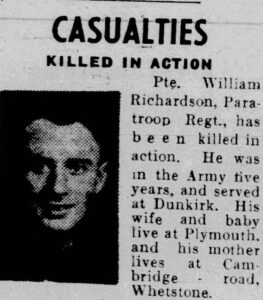
In 1984 George Jennings, ex-Sgt in the 8th Parachute Battalion, wrote the following response to my letter in the Pegasus Journal in which I sought information about the circumstances of his death. He wrote: "In reply to your letter in 'Pegasus' enquiring about the death of your uncle, PTE Richardson, I can enlighten you. The plane carrying us to Normandy on the eve of 'D' Day was hit by German Ack Ack and PTE Richardson was killed by a bullet as he sat in his seat on the plane. The rest of us parachuted and landed near Bois de Bavent and the plane managed to return to England with the body of PTE Richardson in it. PTE Richardson was the Batman of Major George Hewetson, then Company Commander, and attached to no 9 platoon 'C' Coy, 8 Para. I was in the Platoon at the time and later in Normandy I signed a deposition on the circumstances of your uncle's death...PTE Richardson came to us from the Border Regt. I think. He was a quiet man and very well liked by us all."
There is something of a tragic irony about Bill’s death. He had served in France in 1940 and had seen action during the retreat to Dunkirk. However, he was fortunate enough to survive and made it back to England. His service record indicates that he was in France from the 18th April 1940 to the 5th June 1940. It then shows that he was serving at home from the 6th June 1940, until the 5th June 1944 before returning to Western Europe on the 6th June 1944.
Bill was buried in Watchfield Military Cemetery, near Swindon, and his wife added this personal inscription to his headstone "NOT JUST TODAY BUT EVERY DAY IN SILENCE WE WILL REMEMBER. PHYLLIS AND DENIS"
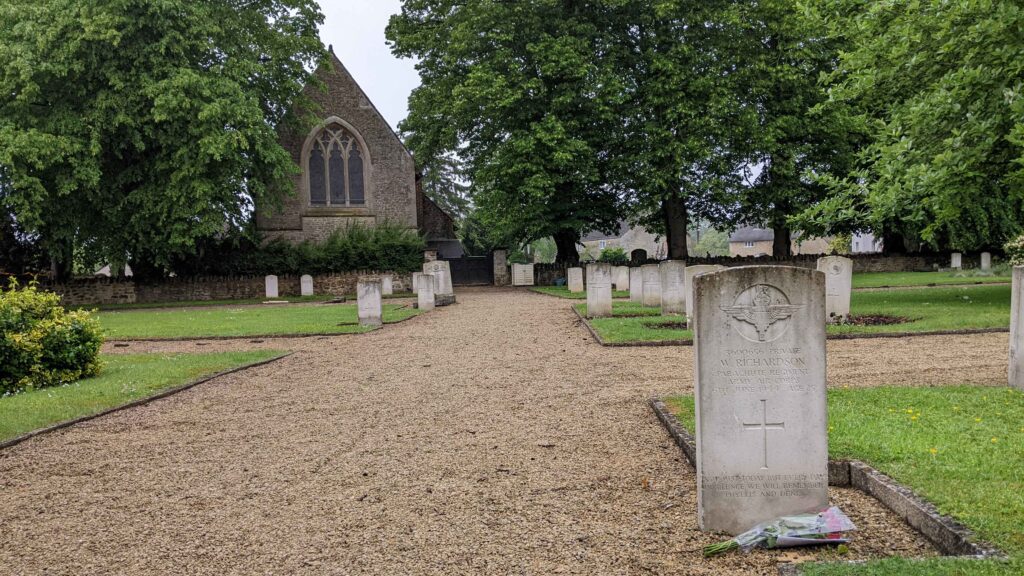
Grave of Bill Richardson, Watchfield Military Cemetery, 6th June 2022
In September 2026 we visited Normandy. After spending a few days visiting the museums and other places of interest in the American, Canadian and British sectors we concluded our visit at the British Normandy Memorial. The memorial is a fitting tribute to those who gave their lives during the Normandy campaign.
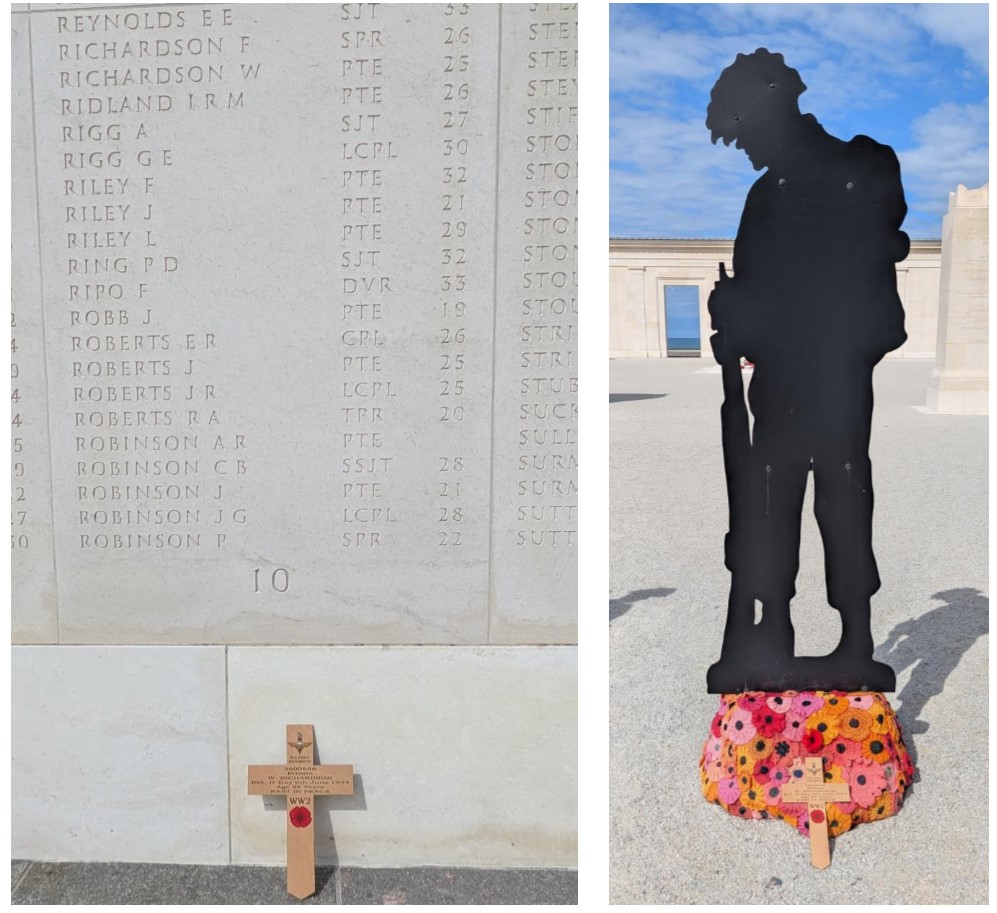
Whether Bill was the first casualty is not important of course. What’s important is that we continue to remember the sacrifice of ordinary men and women like him, who gave their lives for the sake of freedom.
Acknowledgements: Various members of the WW2 Talk website, (particularly senior member “Ritsonvaljos”) who have taken an interest in the circumstances surrounding my uncle’s death and have also researched the history of the 5th Btn, The Border Regiment. Also “Thanks” to Carl Rymen of Geel in Belgium, with whom I have corresponded on a number of occasions and who has written four very detailed books about the Parachute Regiment in World War Two, with a specific interest in the officers and men of the 4th and 8th Battalions.
FALLEN HEROES
WILLIAM RICHARDSON
Army • PRIVATE
Parachute Regiment
8th BattalionDIED | 06 June 1944
AGE | 25
SERVICE NO. | 3600656
FALLEN HEROES
WILLIAM RICHARDSON
Army • PRIVATE
Parachute Regiment
8th BattalionDIED | 06 June 1944
AGE | 25
SERVICE NO. | 3600656
FEATURED SHOP ITEM
£25
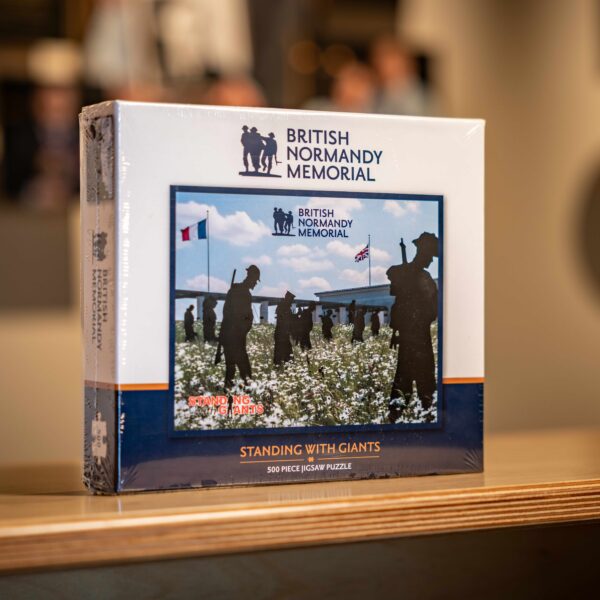
ORDERStanding with Giants Puzzle
Bring a powerful moment of remembrance into your home with our Standing with Giants 500-piece jigsaw puzzle. Featuring the striking silhouettes installation at the British Normandy Memorial, this beautifully produced puzzle captures the scale and emotion of the tribute.
£22
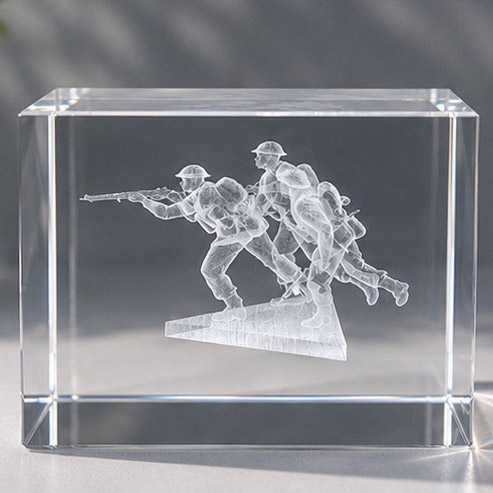
ORDERD-Day Sculpture Crystal Block
Laser-engraved within a solid crystal block, the detailed three-dimensional image can be viewed from different angles, creating a striking display piece.
£16.99
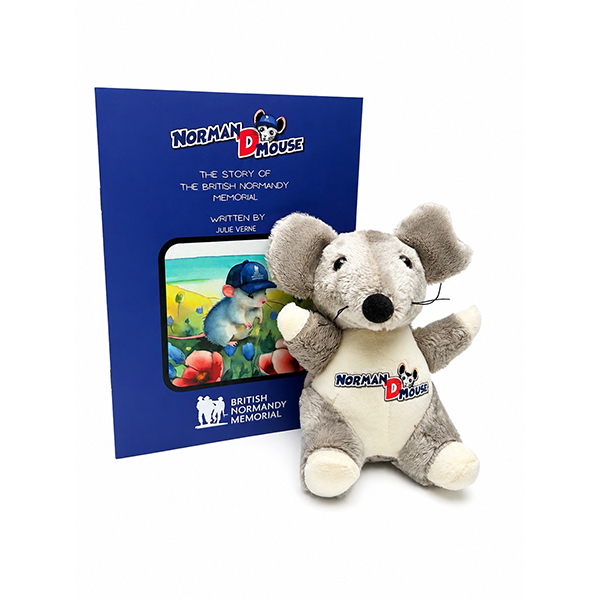
ORDERNorman D. Mouse & Book Gift Set
Meet Norman D. Mouse, the little mouse with a very big story to tell!