



Mohamed Hassan
This story and photos are shared by the Trust with kind permission from Ali Chaudhry, Second World War Historian based in Dubai, United Arab Emirates
Mohamed Hassan was born around 1897, likely in the Aden region of Yemen (then a British Protectorate), and later settled in South Shields, which was then part of County Durham, now Tyne & Wear.
South Shields had a longstanding Yemeni British community since the 1890s, as many Yemenis worked as engine-room firemen on British ships. Hassan was one of thousands of Yemeni seamen in the town, and by the end of WW2 the Yemeni population in South Shields was 3000+. Many Yemeni sailors married local women; Mohamed Hassan himself married Isabella Riella, from South Shields. He had been granted British naturalisation on the 11th September 1935 and in 1937, Hassan was recorded as a “Marine Fireman” residing at 122 Laygate Lane, South Shields.
Described as a fireman (a stoker who fed coal to the ship’s boilers), Hassan likely went to sea young and spent decades in the Merchant Navy. He served on various steamships before and during WW2, engine room roles like his were often filled by Arab seamen (then sometimes called “lascars”) from Yemen and Somaliland. South Shields contributed heavily to the Merchant Navy, and it tragically lost a large proportion of its mariners during the war (approximately one in four of the town’s Merchant Navy casualties were of Yemeni origin).
During World War II, Mohamed Hassan served in the British Merchant Navy as a fireman and trimmer. The firemen worked in sweltering boiler rooms shoveling coal (“firing” the boilers) to keep steam ships running. By 1944, Hassan was serving aboard the SS Glendinning, a steam cargo ship of 1,927 gross tons, owned by George Gibson & Co. of Leith. The Glendinning had been built in 1921 (originally named Sheaf Garth and later Bramwell) and was acquired by Gibson’s in 1940. Hassan’s duty on Glendinning was to tend the boilers and keep the engines running, ensuring the ship maintained speed while in convoy.
In early July 1944, SS Glendinning was assigned to Convoy FTC-27, a coastal convoy from the recently established Normandy beachhead back to London. The ship had likely delivered cargo (supplies for the invasion forces at Arromanches) and on 5 July 1944 was outbound from Normandy in ballast (empty of cargo) bound for the Thames. On board were 24 crew (merchant seamen like Hassan), 7 DEMS gunners, and 2 military passengers (a Royal Navy signalman and an Army storekeeper). Glendinning served as the vice commodore’s ship in the convoy column, which means it most likely was carrying an escorting officer or had important communications duties. German U-boats were still patrolling the English Channel despite Allied control of the Normandy coast, and the convoy moved at only about 7.5 knots under fine weather on the evening of 5 July, the voyage would have likely been quite tense.
On the night of 5 July 1944, while steaming about 20 miles southeast of Selsey Bill in the English Channel, Convoy FTC-27 came under U-boat attack. Between 21:45 and 22:00 hours, German submarine U-763 (Kapitänleutnant Ernst Cordes) stealthily approached the convoy. The U-boat fired a spread of two GNAT acoustic torpedoes and one LUT torpedo. The U-boat captain reported hearing three detonations, claiming hits on two steamers and possibly a destroyer. In reality, only one ship was struck, which was the SS Glendinning.
At about 22:00, a torpedo slammed into Glendinning’s starboard side between the No.2 cargo hatch and the bridge, blowing off the entire forward part of the ship. The blast was devastating and Glendinning’s bow was mostly obliterated. The ship immediately began to tilt and was effectively doomed.
The weather was fair, which aided survival efforts. Captain Donald MacAskill, the ship’s Master, and the crew attempted an orderly abandonment. The majority of those on board, including 24 crew, 7 gunners, and 2 passengers managed to launch the port lifeboat about 15 minutes after the hit. Chief Engineer John Nicol later recounted that the ship’s siren was sounded as the men evacuated, and they worked urgently to clear the port lifeboat. Many crew climbed down into this lifeboat as Glendinning slowly rolled onto her side. Some men, had to jump overboard and cling to floating wreckage in the dark water. Within roughly 30 minutes of the torpedo strike, Glendinning’s stern rose upright and the ship sank at 22:26 hours under the English Channel.
Four men were lost in the sinking, Hassan was a crewman and perished immediately. As a fireman working deep in the ship, he likely would have had little chance to escape the blast. The Army stores officer, Sapper Raymond Tancock, and a DEMS gunner were also killed outright. Captain MacAskill was rescued alive but gravely hurt. 23 survivors, crowded into the lifeboat, managed to row back toward the debris field, searching for those in the water. They pulled 4 men to safety. The convoy’s escorts responded quickly as well. HMS ML-250, a Royal Navy motor launch (Lt. Cdr. J. D. S. Header commanding), dashed to the scene and located two men in the water, Glendinning’s chief officer and radio operator, and pulled them to safety. ML-250’s crew also spotted Captain MacAskill floating unconscious and, heroically, two Royal Navy sailors dove overboard from the motor launch to rescue the captain, who had suffered a skull fracture along with other injuries.
The survivors, including the injured captain, were subsequently moved to the escort HMS Fernie (K-class escort destroyer) around 23:15 hours. Despite intensive medical efforts by a naval doctor aboard Fernie, Captain MacAskill sadly died of his wounds before morning. Overall, 4 men died and 29 survived. The survivors were transported to shore and landed at Sheerness, Kent at 13:30 on 6 July 1944. One report noted, “shaken men, covered in oil and salt, stepped ashore, grateful to be alive after their ordeal.” Mohamed Hassan however was lost in the freezing waters when the ship went down. He was 47 years old.
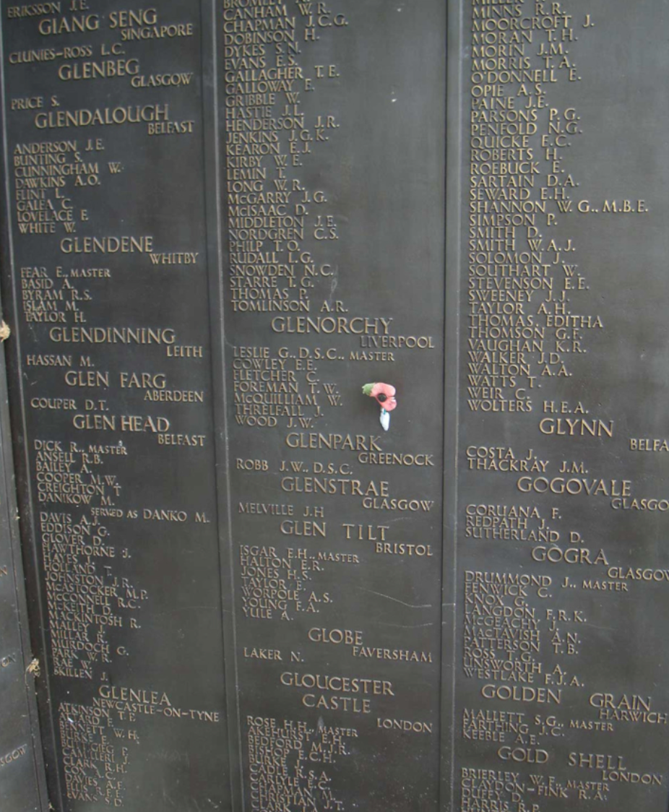
Fireman Mohamed Hassan’s sacrifice is honoured and remembered in multiple ways. Like so many Merchant Navy men who “have no grave but the sea,” he is commemorated on the Tower Hill Memorial in London. His name is inscribed on Panel 52 of the WWII section of that memorial (under the listing for SS Glendinning). The Tower Hill Memorial, maintained by the Commonwealth War Graves Commission, lists Hassan among the thousands of merchant mariners lost in WWII. His Debt of Honour entry records his age (47) and rank (Fireman) and notes “Husband of Isabella Hassan, of South Shields, Co. Durham.”
Isabella, his widow, presumably received official notice of his death some weeks after the sinking, and his name would have been published among casualty lists. In South Shields, Mohamed Hassan is also remembered on local rolls of honour and notification about his death appeard in the Shields Daily Gazette of the 1st August and the Newcastle Journal of 3rd November.
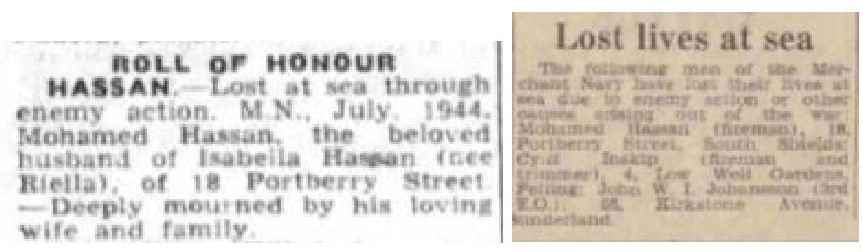
L-R: Shields Daily Gazette, 1st August 1944; Newcastle Journal, 3rd November 1944.
The South Shields Book of Remembrance (1939–45) includes “Hassan, Mohamed – 18 Portberry Way” among the town’s fallen.
I have added a picture of his Tower Hill memorial, his name is placed on the left side column. Captain Donald MacAskill, the Master of Glendinning, was buried in Gillingham (Woodlands) Cemetery in Kent with full military honours. The two naval and army personnel who died are commemorated on separate memorials (the Royal Navy gunner on the Plymouth Naval Memorial, and Sapper Tancock on the Brookwood 1939-1945 Memorial). But as a Merchant Navy civilian, Hassan’s principal memorial is Tower Hill. Additionally, Mohamed Hassan is listed at the British Normandy Memorial under the date 5 July 1944, recognizing that he died in an operations related to the Normandy campaign.
I was not able to find a picture of Mohamed himself. However this could be the very first casualty identified of a middle eastern national in the Normandy Campaign.
British Normandy Memorial - Additional Information
Unfortunately, we do not have a photo of Mohamed Hassan. If you are aware of one, or you are related to Mohamed, we would love to hear from you so we can add to his story.
FALLEN HEROES
MOHAMED HASSAN
Merchant Navy • FIREMAN
Merchant Navy
SS Glendinning (Leith)DIED | 05 July 1944
AGE | 47
SERVICE NO. |
FALLEN HEROES
MOHAMED HASSAN
Merchant Navy • FIREMAN
Merchant Navy
SS Glendinning (Leith)DIED | 05 July 1944
AGE | 47
SERVICE NO. |
FEATURED SHOP ITEM
£25
ORDERStanding with Giants Puzzle
Bring a powerful moment of remembrance into your home with our Standing with Giants 500-piece jigsaw puzzle. Featuring the striking silhouettes installation at the British Normandy Memorial, this beautifully produced puzzle captures the scale and emotion of the tribute.
£22
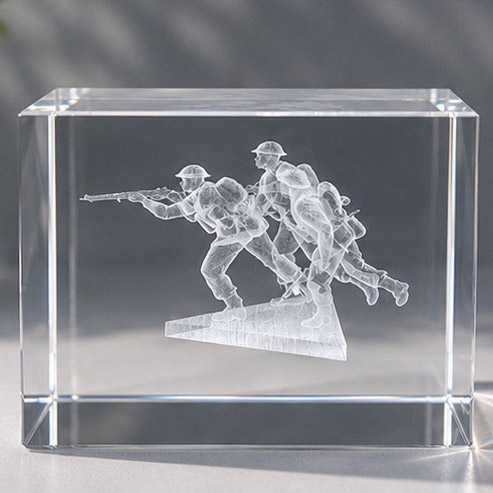
ORDERD-Day Sculpture Crystal Block
Laser-engraved within a solid crystal block, the detailed three-dimensional image can be viewed from different angles, creating a striking display piece.

£16.99
ORDERNorman D. Mouse & Book Gift Set
Meet Norman D. Mouse, the little mouse with a very big story to tell!